
A Secret tale

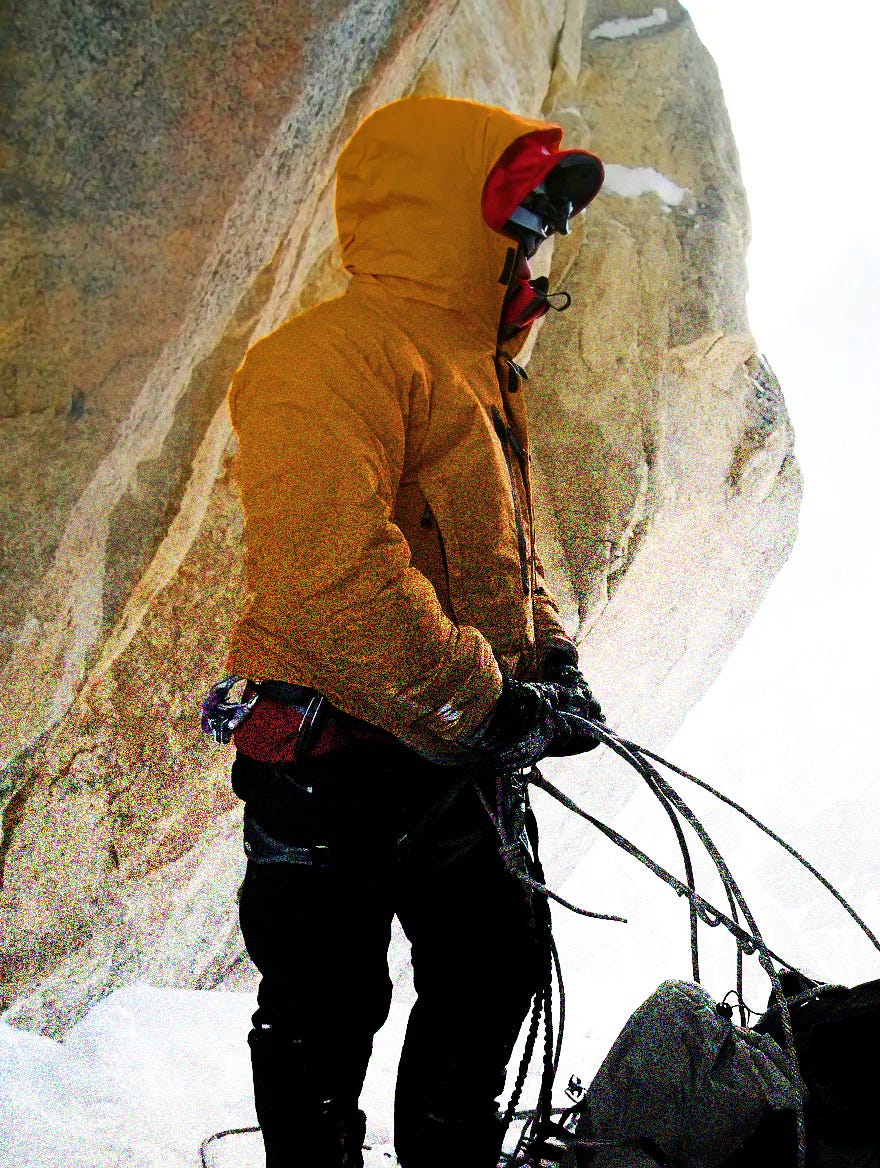
I dug this photo out last week for my GriGri piece. It was taken by Ian Parnell just before he set off on his lead on Cerro Standhardt during our failed winter attempt — a trip that Alastair Lee somehow turned into an award-winning film. (Yvon Chouinard called it one of the best mountaineering films ever made, which is funny, as there’s hardly any mountaineering in it.)
Every photo tells tales. That’s why, no matter how shit, blurred, under- or over-exposed it is, no photo should ever be thrown away or deleted. Often, in the long run, the worst ones have the most to say.
Although some photos tell it all — like a landscape or a sunrise — the best are like puzzles, or like a great painting: the more you look, the more you see, and the more you question. Some people are naturally good at looking, wondering what stories or lessons are hidden inside the frame. What can they learn?
For example, in this picture, someone might notice I’m not using a figure-of-eight or a bowline as a tie-in, but something else (it’s a Kiwi tie-in knot, a variation of the fisherman’s knot).
Then there are the stories to puzzle out: where were we on the route, what happened next or before, and all the stuff in between? Who was the photographer? How did we know each other? Where did our lives go after this pic?
This puzzling quality of old photographs is one reason I love seeing the B-roll images from famous climbs — the shots that weren’t good enough for the magazines or books at the time and were therefore long forgotten.
Maybe others feel the same, but I’ve found that old climbs and adventures eventually have the memory of the experience itself replaced by the key images you took. The climb becomes little more than a slideshow in your head.
To test this theory, the last time I went to Yosemite I didn’t take a camera, only a shitty old phone. The problem was that my partner Tom didn’t get any nice pictures from our climb, while I did — because Tom had both an iPhone and a fancy DSLR. As a result, my experience was thoroughly documented and now forms the memory of the climb, while Tom’s was not. (I’ll have to ask Tom if my theory was correct.)
As for these forgotten images, these days you’ll often find them on Instagram (such as the doug_scott_archive), where old climbers or archivists revisit and re-scan images that no one was interested in back then — usually rejected by a magazine editor. These dusty, neglected slides, or long-dormant digital files, once rediscovered, are like a mosaic in a Roman urinal; they have become archaeological treasures. Archaeology, after all, is the business of reconstructing the stories of dead things.
I’ve always been wary of sharing old images too much, as it’s often a sign you’re past it — like doing slideshows about climbs that happened ten or twenty years ago. Just as the Victorians viewed nostalgia as a mental illness, so perhaps is dwelling too much on the pictures you once took. Now, when I see some old climber posting tons of old slides every day, I always imagine they must be on their last legs, or at least sitting at home convalescing, having just been gifted a new pair of knees or hip.
And then there are the secret stories images don’t share — the ones that belong only to those captured, and to those doing the capturing.
In this case, I have mixed emotions about this photo, and that trip, and about this period in my life. Yes, I look like I’m in hero mode, living the dream, but the reality was very different. I think both Ian and I were just going through the motions, and we both moved on to other lives not long after this, via a winding stair.
But the main story this picture tells me seems quite trivial now: this was the first trip I ever went on where I wasn’t wearing the clothing I believed to be the best for the job. Instead, I was wearing the clothes I was being paid to wear.
Having worked in outdoor shops all my life, I’d always been able to buy and use the kit I thought really worked. In the early days that meant Buffalo clothing (still the best, I think, for what I do). Later, when I got a job as a clothing tester for Patagonia and then became one of their ‘athletes’, I had plenty of high-quality kit to choose from. That choice was made easier because I was also working on developing Buffalo-esque clothing for Patagonia (the Inferno jacket, Mixed Master, and so on), so I was directly involved in what I could use.
But when this photo was taken, I had just started a very well-paid job with Berghaus. (How well paid? I’d asked for an outrageous amount — twice what I’d earned in my outdoor shop days — and they offered me half of that.) I took the job because I was in a flux period. I felt I needed to sort my life out, go straight, be sensible — to fold. To make as much money as possible. It was probably around this time that I also decided to give up writing; it took up all my time yet earned me the least money.
The downside of taking Berghaus’s coin was that they had a very limited range of kit suitable for this kind of climb, or the kinds of climbs I did. They had a line called Extreme, but none of it felt truly extreme. I’m sure most climbers given free Gore-Tex and Polartec clothing would have been more than happy (Ian was sponsored by Arc’teryx, so he had the same kit really, just 200% more expensive), but for me — having developed my own idiosyncratic way of dressing for such climbs — nothing seemed to work. I spent the whole trip cold, damp, and miserable.
For example, the belay jacket I’m wearing in the photo looked ideal for winter climbing in Patagonia, just like the Patagonia DAS parka I’d lived in on lots of other climbs. It had been picked from an already defunct ‘Big Wall’ range, yet it had the unusual property of being neither waterproof nor breathable. It let water in but wouldn’t let it out. This was made worse by a waterproof inner lining, so the jacket never dried out. It also achieved the rare feat of being both heavy and not warm.
The rest of the kit was standard Gore-Tex and Polartec — meat and two veg — that just seemed stiff and sweaty. Most of the time, I just wore the stiff Gore-Tex shell over the top to protect me from my own belay jacket.
The only things that delivered any real performance were my old Power Stretch Patagonia pieces (Berghaus didn’t make Power Stretch) and my Brynje mesh underwear.
I’m not saying the kit played a part in us not getting up the mountain — we bailed later that day anyway — but when you have a really good clothing system, you feel invulnerable to the storm and completely at home in it. In that mental state, you’re happy to hang on much longer. When the system is wrong, you feel naked, especially when you stop moving. At any moment when bailing is an option, you take it.
My days with Berghaus didn’t last long, mainly due to my big mouth, loose-cannon nature, and lack of political skill. I wrote a mad manifesto to the CEO explaining how they needed to spin off the Extreme line into a separate grassroots enterprise if they wanted to recapture what Berghaus had once been (I made the error of thinking they actually wanted to). The result was the product manager telling me to stick to climbing — which was fair enough (one of my faults is caring too much about stuff I don’t have to care about, or get paid to do).
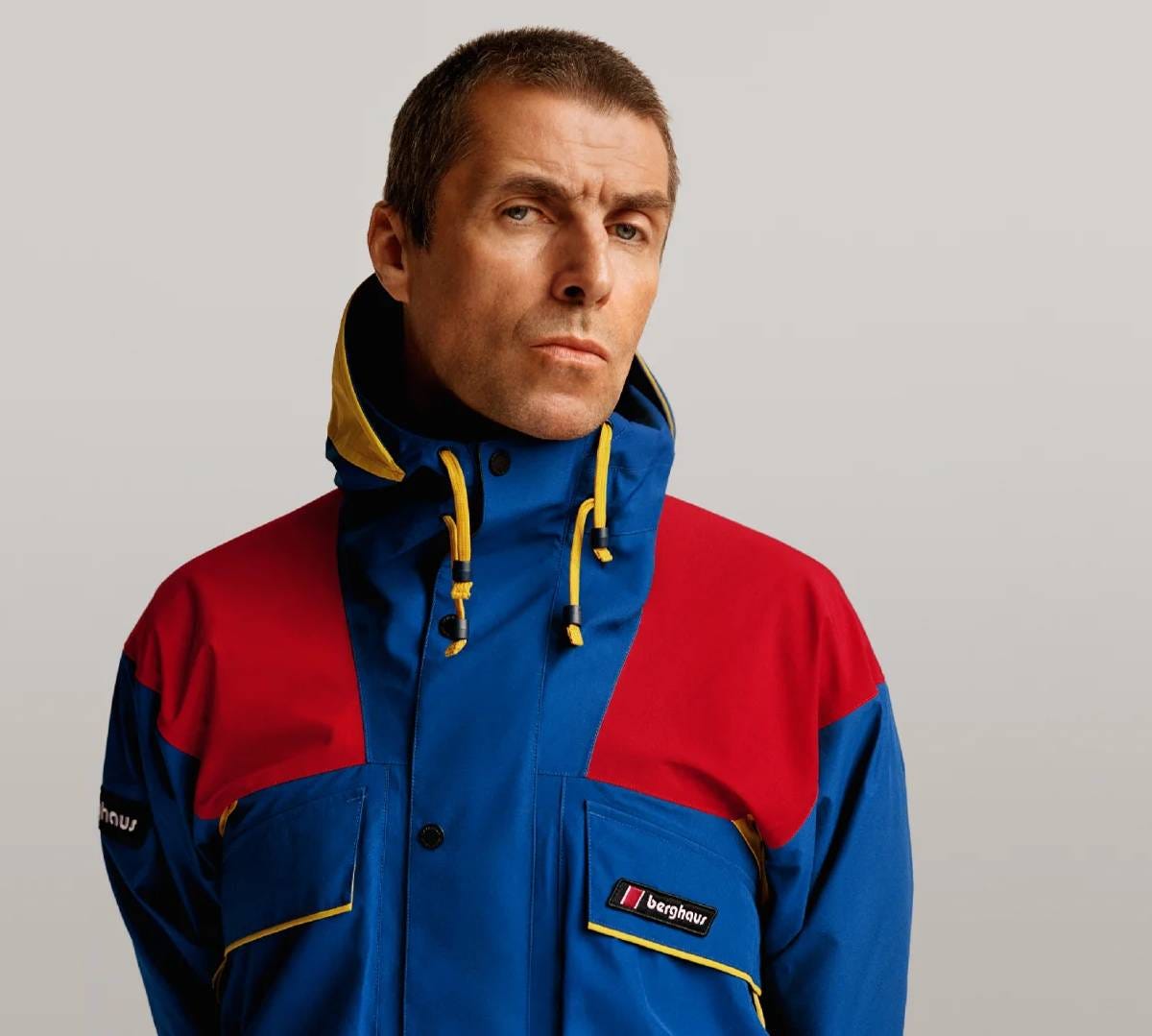
I also made a joke at a big event. When they said that Berghaus customers were either “fresh air” or “cool air” (I still don’t know the difference), I asked, “What about dog hair?” Berghaus was, after all, the premium supplier of jackets for UK dog walkers.
I was never happy putting my name to products I’d had no part in creating — or didn’t even think were any good. In the end, I suppose I fell into the most common trap faced by sponsored climbers: the Big Sell-Out.
At least it was still the 2000s, so I didn’t have to regurgitate marketing guff on my socials: how excited I was to be wearing my new eCoShite shell (aka my own-brand Chinese knock-off of a fabric that could be bought for a fraction of the price of Gore-Tex), or telling people who to vote for, or to live a smaller life while still being a good consumer and happily funding my fast-fashion sponsor.
Later, at another event, Chris Bonington — who I’m sure had put in a good word for me when I got the job — simply said I’d “dropped the ball.”
But it just wasn’t me. Even though I was giving up a big chunk of my income, I left Berghaus soon after. I didn’t tell anyone, and my girlfriend — who was also sponsored by Berghaus — only found out via an email to all the other athletes that I’d gone. “What are you going to do for money?” she asked, which was a good question, just one I’ve always left to its own devices (Jah Will Provide).
Later, I looked back at my Berghaus time, an ex-sponsor, that girlfriend, who also became an ex, my wife before that, another ex, and so many other exs, and saw them all the result of the same behaviour and compulsion. I tried so hard to gain things that, once I’d got or achieved the focus of all my ambition and hope, they just became worthless, or worse, a threat. I either neglected or disposed of them, because I wanted to do the throwing away, rather than being thrown away myself. I was always ducking out. My life was really all about building impossible bridges, then burning them down, then moving on to another part of the river and building another. Self-destruction 101. It didn’t know it then.
But I do now.
And so, when I look at this picture — just me, standing there belaying, not a fantastic or remarkable image at all, nothing to no one, just me, just some lifeless code on some somewhere server, of no value to anyone — this is the secret tale it tells.