
Death of Lion
What does the retro bolting of Snake Dyke and big game hunting have on common?


The bolting of Snake Dike has been all over my feeds lately, making me feel like I should write something—mostly in defence of this once five-star route. But how? How do I write about this in a way that isn't just a Xerox of what everyone else has already said?
Well, how about we start in Africa…
In 2018, I spent a couple of months travelling and climbing in Namibia—a country every climber should visit once in their lives, to climb in Spitzkoppe, and scale the Matterhorn of Africa. One day, while sitting in a cafe in Windhoek, I got to talking with a South African professional big-game hunter who looked straight out of the pages of a Hemingway novel. You don’t get to talk to many African game hunters these days, so I struck up a conversation, open-minded and without judgement; I just listened as he listed the hardest animals to track and shoot.
When I asked him how dangerous the job was, he described a few hair-raising encounters, mostly with buffalo, and spoke of people he’d known—both hunters and guides—who had been killed or injured. Sometimes it was by the animals they hunted, but more often it was from mishandled guns or vehicle rollovers or other people. He described the unique thrill of the pursuit, of tracking early in the morning, when the dew was still fresh, explaining that once you hunt something that can hunt and kill you back—an animal that still charges even after you’ve shot it dead—you’re never the same again. The Great Game.
There was something else he told me, before we parted, that came back to me when I saw the story Snake Dyke, but I’ll save it to the end.
21st-century climbing has been strangely devoid of cultural flashpoints, beyond the odd bushfire. Gone are the bolt wars, the chalk wars, the chipping wars, and the war against siege climbing. Sure, you might believe there have been mighty crusades against misogyny, lack of diversity, “problematic” route names, and people, underrepresentation, and racism— but – to me – this is all noise and no signal. It is most often used as a way for people with nothing else to say, or add, to find a voice, or, more often, for dying media to appear at the cutting edge rather than the chopping block.
These days, climbers seem pretty apathetic, or at least the ones I talk to, having adopted a more laid-back, The Dude-like “live-and-let-live”—or “live-and-let-bolt”—approach to climbing. Maybe I’m wrong, but I always got the impression that when old school climbers clinched their fists when you mentioned adding a bolt or ten to some leg-braking classic, they were doing so on behalf of future climbers; future climbing. Now, the future spans no further than one’s personal ambition. “How about I add a line of bolts to Indian Face, and turn an E9 6c into just another 6c?”, “Dude, that would be sick!”.
The traditionalists who would have once died to protect a stretch of blank rock from a drill, or driven to another climber’s house to punch them in the face for using pof on a gritstone boulder problem, have either passed away, moved on, or been exposed as hypocrites—men who threaten righteous anger if anyone bolts a dank, green, vegetated crag at home (and make it alive for some), while happily clipping bolts in the Costa Blanca all winter.
I’m not really being judgemental here, as I’ve placed many a bolt myself, even chipped the rock here and there; this is more about something deeper than 55mm.
The litmus test of how easy we’ve become as climbers has come in the shape of the recent retro bolting of the Yosemite classic Snake Dyke (5.7 R) (see Half Dome has Fallen). Sixteen new bolts were added to the first three pitches (so far).
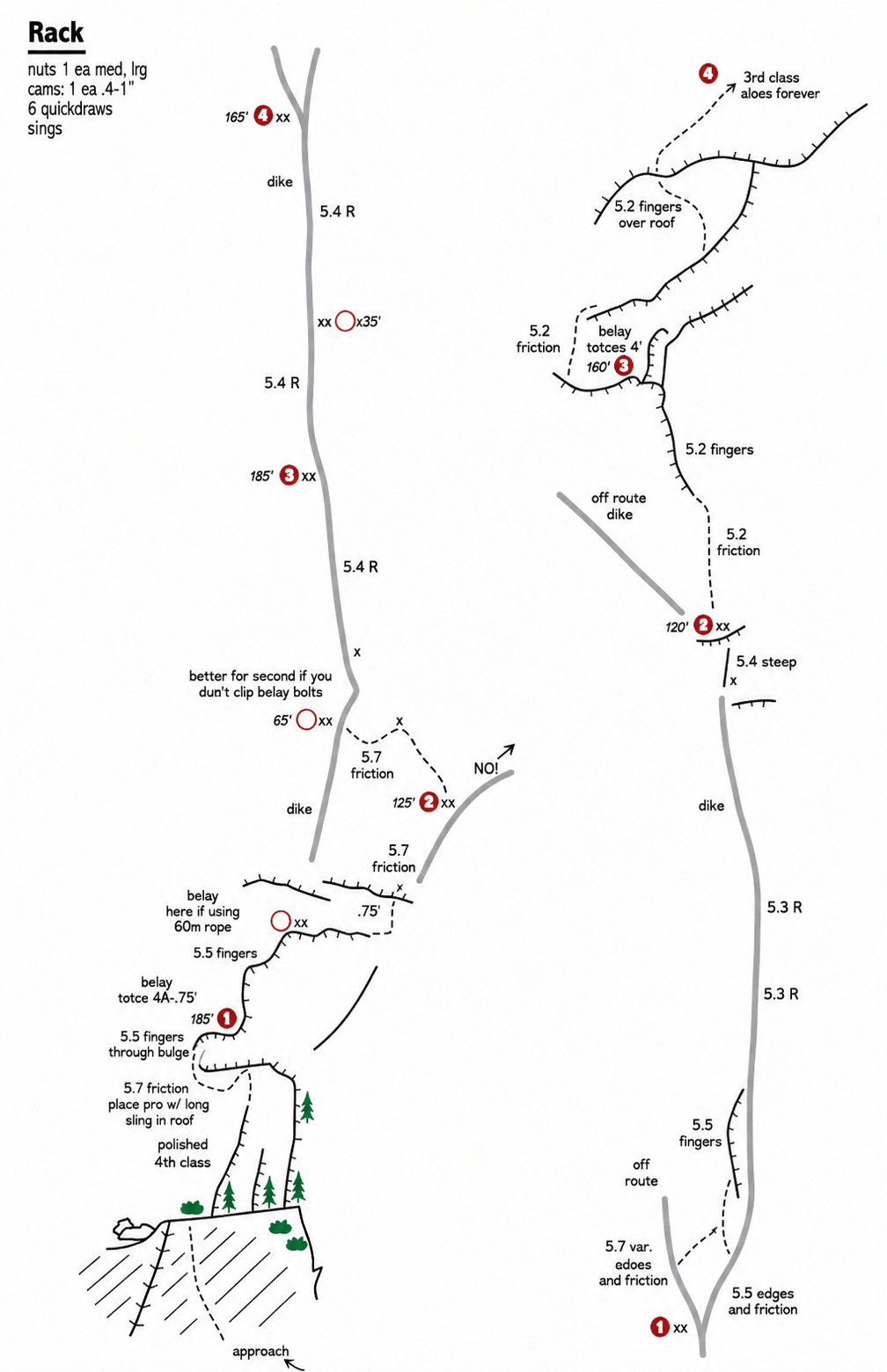
Although I’ve spent a significant portion of my life in Yosemite—several years, if I add it all up—I’d always stayed away from Snake Dike (I always wanted to solo it naked on a full moon night, while on acid). I assumed it would be a total shitshow, and it was. When I finally climbed it in 2019 (fully clothed, and sober), it proved to be one of those routes that requires a lot of walking (like, a lot), a little bit of climbing (three or four pitches), a lot of scrambling, a shit-your-pants descent, and then even more walking. But it was a five-star day.
Sure, there are some run-out bits, like a whole pitch with a single bolt—or no bolts if you miss it (if you can run out 20 metres, why not 40?) —but it’s the type of climbing that the late Alan Mullin would describe as impossible to fall off (”you’d have to jump off if you wanted to fall”). Yes, there have been fatalities and serious injuries, but I don’t believe they were directly related to climbing run-out 5.7 R. Instead, they stem from rappelling and tethering errors, or getting off route—which is easy to do if you think you’re following someone up Snake Dike when you’re actually following them up a very run-out 5.10b, Eye in the Sky. And as Chouinard used to say, “more people die eating bad mayonnaise”.
The real danger would be rocking up having never climbed a Yosemite granite slab, only to find yourself on a 5.4 pitch, forty meters above the belay without any gear, too afraid to step up and too afraid to step down. But even then, the fact that you’d have ten parties behind you and ten above means you can easily just get rescued.
For me, the biggest risk on that day was with a pair of soloists, a guy and his girlfriend, where the guy was far more able to free solo than his partner (if you want to climb solo, do it solo, and avoid crowds, unless that’s why you do it).
By the time I climbed Snake Dike, I was comfortable-ish on 5.10c slabs, which are often very run-out, so the whole thing felt more like a scramble. Yes, it was run-out, but so is walking along a steep mountain trail, or riding a bike down a city street; if you make it to that point, you won’t fall off.
“But what about a 5.7 leader?” I hear you ask.
Fuck ’em, I say. If they can’t climb run-out 5.7 slabs, they’re not a 5.7 climber. If you want to take that hand-holding approach to climbing, go ahead and chisel ten thousand steps up the Southwest Face so your grandma can climb it and say she did Snake Dike. You’re not given the grade you climb by a single tick; you earn it.
Ultimately, what I’m saying is that Snake Dike is actually boring. It offers a nice position, a nice long walk, and a great view, but it’s boring. What saves it from mediocrity is the spice of the run-out—the feeling of mastery you get when traversing unprotected, no-man’s-land slabs. It’s the same feeling a sailor must get when crossing an ocean or a rough passage. It’s less about the technical moves; it’s about getting it done well, and staying in total control.
This event—the adding of bolts—might be greeted with a shoulder-shrugging “Meh” by most climbers, who view the sport as nothing more than vertical CrossFit or golf, just another pre-packaged lifestyle buy-in. But to me, it’s one more sign that what climbing once was is dying: a counterculture, a rebellion against safetyism, a Hell’s Angels life for people who can’t ride bikes or grow beards. It’s not meant to be high risk or dangerous, and - God forbid - exclusive and elitist; it’s got to be safe, inclusive, and for everyone.
Yes, people will no doubt chop the bolts, but again, that's another litmus test: see how people view that act of counterterrorism (yep, adding bolts is terrorism in the form of anti-terror). The real crime isn’t going to be viewed as the death of Snake Dyke; its neutering; it’ll be the act, by some, to bring it - and what climbing once was - back from the dead. But really, it’s done. The world had moved one dude. Stop fighting. Give in.
Oh, yes, the hunter. What did he say before we parted ways in that Windhoek cafe?
I asked him if hunting ever kept him awake at night—if there was any guilt or sin after a lifetime of killing. No, he said. But things were changing, and that did trouble him. There were more and more clients, mostly Americans but also Europeans, who wanted to hunt big game with minimal effort or risk. This had led to the common practice of drugging wild animals, often old or sick—like gladiators in the ring facing emperors—and guiding the “hunters” straight to them for an easy kill.
“Why?” I asked. I’d never even held a gun, but even I saw this as a sin.
“Because,” he said, “all they care about is the trophy.”
Perfect analogy, Andy. I added this comment on one of the discussions: “Better raise our skill than lower the climb.”~Robbins. That’s all I wrote, thought it was self explanatory. Was pretty stunned by the blowback, lots of it. My crusty old person’s opinion is that it’s a fallen world. Others just don’t see it this way. Thanks for your words~
Dude, great piece 👍.