
Inside-out or Outside-in?
What way to thread your rappel ropes

Although my book Down has sold over 12,000 copies since 2019 (hopefully, that means a lot less stupid rappel-related deaths!), I’m surprised by how little criticism or argument it’s created, such as X knot is wrong, or Y technique is dangerous. Mainly, the only criticism is about spellings and grammar (guilty), or the structure of the book (show me a better way and I’ll do it). I know if I published it paragraph by paragraph on climbing forums, like Mountainproject or UKC, anything and everything would be deemed wrong by someone, and all the text and diagrams would be pulled to pieces. I guess, when you go to all the effort of writing an actual book, people tend to be a little kinder (or maybe it’s just that books have no comment section, only Amazon reviews).
But, one thing that does crop up from time to time, both in reviews of the book, in emails asking for clarity, and by people you meet at the crag, is this short paragraph about threading your rope through the abseil anchor, such as a quick-link, rappel ring, sling or cord.
Inside-Out
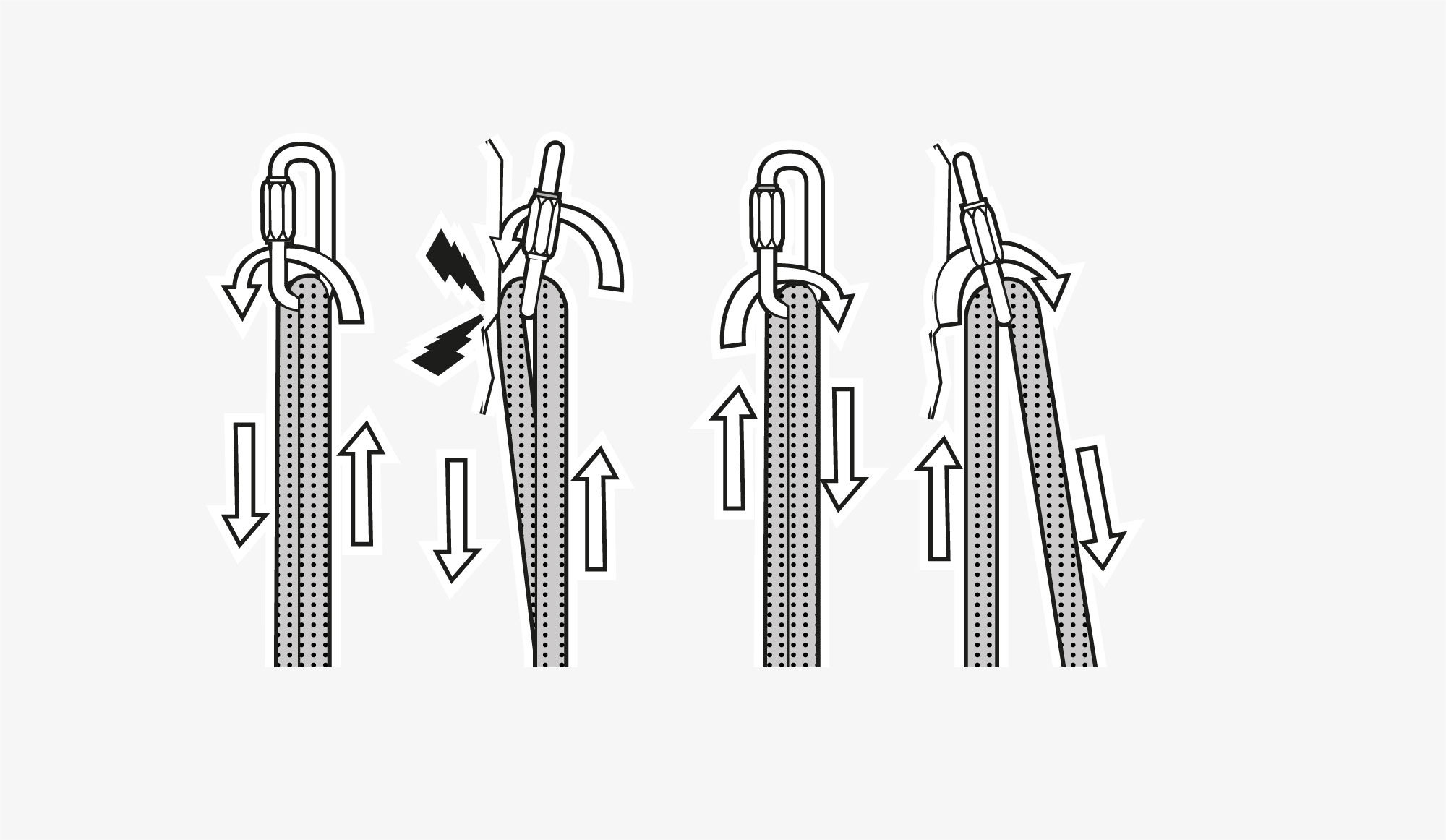
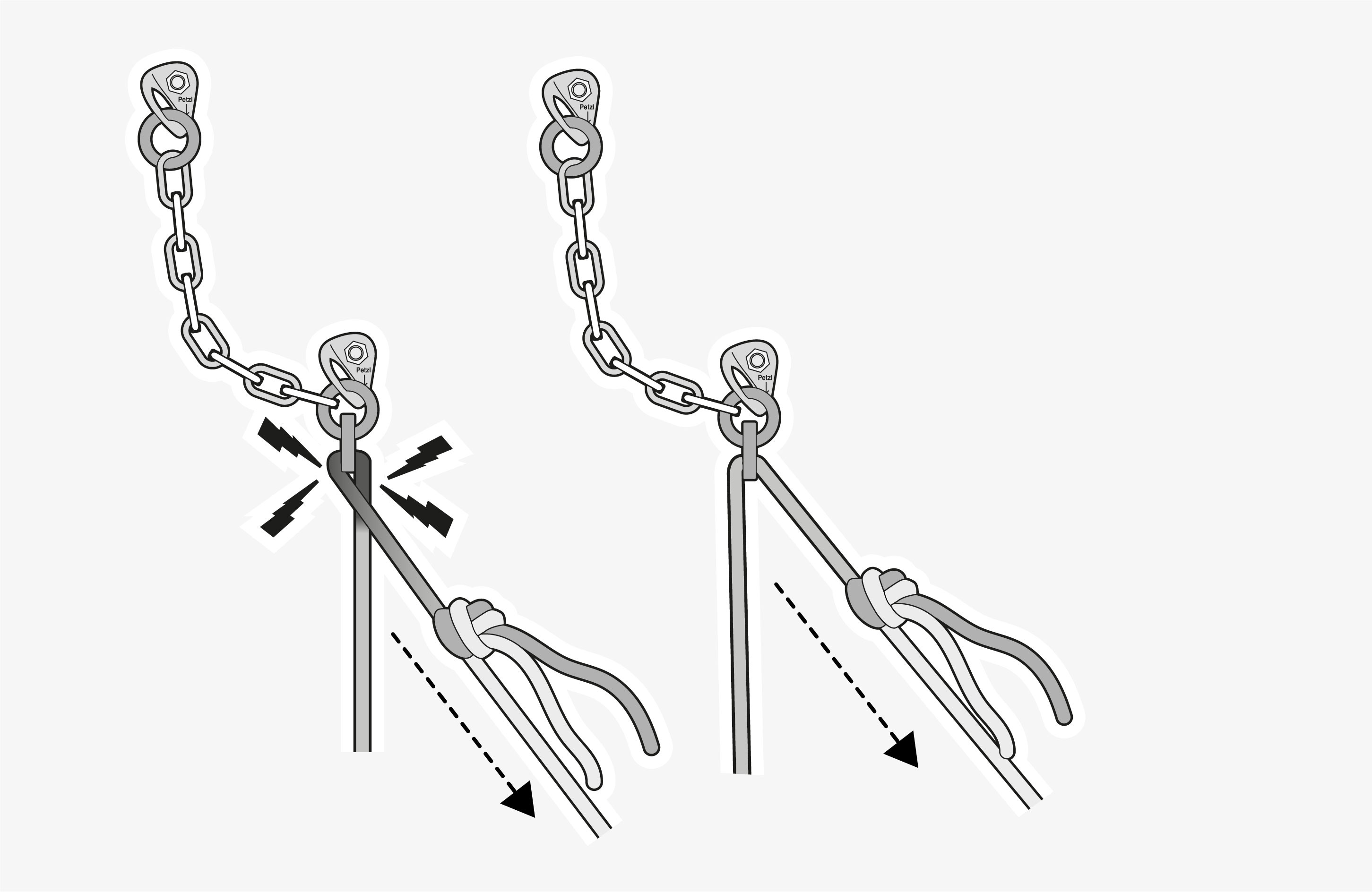
The ideal abseil-point is one that is at a right angle to the rock face, as this limits abrasion of the ropes and so also reduces friction, but often an abseil-point will be parallel to the rock. In such cases, you should always aim to have your rappel ropes threaded from the inside out, not outside in. The reason for this is that when setting outside in, when you pull the rope, it can pinch the rope between the abseil-point and the rock, as well as increase the surface area of rope running around the abseil-point. The second advantage of this approach is that it puts your rappel knot on the outside, which reduces the risk of the knot running into trouble on ledges and edges.
This approach, like almost everything in Down, was not defined by dogma, as in “this is the way I was told” , but by practice, doing hundreds, if not thousands, of rappels. I have all sorts of teaching moments where I came up with this way of threading a rope.
One such moment was one night in Namibia, rappelling down a desert dome without headtorches, but off solid bolted anchors, only to find our ropes would not pull (Murphy’s law tells you that if you’re already having an epic, other epic problems will occur). I tied into the end of both ropes, and then hand over handed back up to the anchor (being a slab, it was easy to ‘batman’ up), only to find the only problem was I’d threaded the rope outside-in, but when the rope was pulled, it caused the quick-link to pinch the rope against the rock. The more you pulled, the greater the pressure on the rope. All I had to do was rethread for an inside-out pull, get my partner to do a test pull (it worked), and then rappel, and pull the ropes. This time they came down.
There had also been several times when I knew I’d have had a really hard, high-friction pull on the pull strand. This was made easier if I could walk away from the base of the crag. But, if I threaded the rope outside-in, the further away from the fall line, the more the rope would wrap around the hard link or sling.
And then there was the belief that when you threaded inside-out, when you pulled the rope, especially if you whipped it fast as the end neared the abseil point, the end would fly out, and away from the wall. Outside-in, would see the rope fall down the plumb line.
Of course, in reality, I expect much of this is just theory, how you think things could be, or might happen, but in reality, they do the very opposite. But sometimes, if your theory is correct, it could save your bacon.
But, it seemed that a lot of people thought this was wrong, that “the way” was always to thread your ropes outside-in.
It’s hard to nail why this is so, and it was probably based on something someone wrote in some book or magazine in the 1960s or 70s, like Joe Brown or Royal Robbins. The reasoning was that inside-out could trap the rope, the rappel sling being forced against the rock as the rope was pulled. By threading inside-out, when you pulled, you pulled the sling away from the rock (theoretically).
The problem with this, outside-in, and inside-out, is that no two rappel anchors are ever the same in terms of the profile and angle, or anchor material, varying from cord to webbing, or threaded through a hard link, be that karabiner, quick-link, chain-link, or rap ring. Then you have different diameter ropes, as well as rope lengths, plus whether they are dry or wet, new or old, static or stretchy?
Really, 99% of the time, it doesn’t matter if it’s inside out or outside in; it won’t make a difference either way (if you’ve created a good rappel anchor). And in the 1% where it does matter, it’s 50/50 how best to thread the ropes.
What matters is to be aware that how you thread your ropes, their direction of travel, can affect the pull, and keep that in the back of your mind. But most of all, this issue is a non-issue as long as you follow something far more important in terms of standard operating procedure when rappelling, which is the pull test. By the first person down, do a very short test pull on your ropes; you will avoid so many epics, far more than arguing at a rappel station, or on a forum, about what is “the way” to thread a rope.
Happy Christmas!
Having had a double nightmare on a Costa Brava multi-pitch only earlier this month, I felt the angst & horror return even just sitting at home.
When I climbed back on both apparently jammed ropes I found that, having re-set the ropes after my partner went down, checked they’d pull correctly etc., both ropes had somehow made for a nasty bottle shaped crack away from the line of the ab.and the knot had found a snug bed to jam into!
What’s worse is the second pull-through ended-up with one end of the rope releasing so much tension that it whipped out of the ab. ring and wound itself around a rock with a grim undercut… twice! Here’s the image of the latter incident! https://photos.app.goo.gl/fjrRwn86fUivPyhb9
Down—excellent resource! Thanks.