
Murder-Suicide - the Case Against Simul-rappelling

We live in an attention economy that can feed on either positive attention—beauty, talent, and mastery—or negative attention—mediocrity, pornography, and rage. The problem is that the latter requires only a fraction of the effort. There is no shortage of things on social media designed to enrage us, make us despair, or tempt us to give up.
Over time, we become inoculated against these effects. We grow numb, learn a kind of helplessness, and require ever larger doses to provoke the same response—to make us feel anything at all. Yet this numbness extends to the positive as well. Eventually, we stop paying attention altogether. Anything that asks for our attention begins to feel transactional, and so we look away.
There is much that once made me react, to share and comment, but not anymore. As for getting angry, the moment I feel that response, I try to visualise some third dan martial artist, who controls his emotions, centres himself, so as not to allow his animal nature to be gauded into defeat.
All very Zen.
But, if there’s one thing that does get my blood up, it’s people talking about, or promoting, the so-called climbing technique of ‘simul rappel’, something I’d categorise as murder-suicide.
What is Simul Rappeling
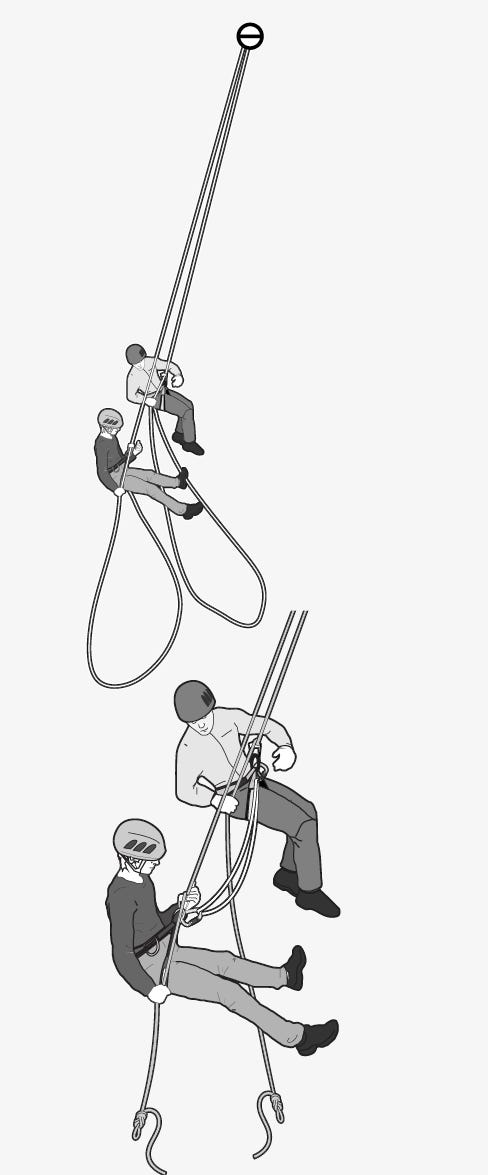
Unlike a standard rappel, where climbers descend one at a time on the rappel ropes (or on a single rope when using a blocking method), simul-rapping (SR) has both climbers descending simultaneously, each on one strand of the rope. In theory, they move at the same speed. One is on the “up” strand, the other on the “pull” strand.
The attraction is obvious. By descending at the same time, you cut the rappelling time in half. In theory, that makes you 100% faster. And when you see high-profile climbers like Alex Honnold, Tommy Caldwell, and Cedar Wright simul-rapping, it is easy to conclude that this must be the way forward, and that anyone who doesn’t embrace it is either out of date or simply a nervous ninny.
Of course, the history of climbing is littered with techniques that looked efficient right up until the moment they weren’t. When it comes to SR, I’d modify that old aviation-safety line, “If you think safety is expensive, try having an accident,” to: “If you think being safe is slow, try having an accident.”
Personally, I don’t think there is any place for simul-rappelling. In fact, I’d go further and say it’s fucking stupid, something anyone outside of the US seems to understand. To the climbing community, it’s what Russian roulette is to the shooting community. I’m not saying people shouldn’t do it. Alex, Tommy, Cedar—it’s a free world. But just as I’m not going to tell people not to have sex with farm animals, I’d prefer they keep it to themselves. Otherwise, people might start thinking it’s normal. I’d argue that both sheep-shagging and simul-rapping are really cries for help. If you’re going to increase your chance of dying by a large margin, to save a few minutes, and you’re just out cragging, and it’s not a life or death descent, where every second counts, then what the fuck’s wrong with your head?
As for calling it murder-suicide (the trick of which is getting the order right), I would say that, in my experience, SR is often not a high-risk game played between equals. More often, it’s one person demonstrating an obviously dumb technique to someone who lacks either the experience or the confidence to say, “No thanks.”
Maybe I’m being too harsh? Read this, just one example of the tragic consequences of an SR:
Before the accident, the two climbers had climbed Lunatic Fringe, a popular 5.10c single-pitch route. After leading, John remained at the anchor at the top of the climb to belay David up. The two climbers then decided to simul-rappel, with each climber rappelling one strand of the rappel rope, so that each climber would counterweight the other. David used a Petzl Grigri, while John used a Black Diamond ATC device. They were using an 80-meter rope, both ends of which reached the ground from this anchor, with no extra.
During the rappel, John was beneath David and remembers David stopping or slowing down at some point. John reached a small, sloping ledge about 15 feet above the ground and waited for David to catch up. According to the post-accident analysis, David was roughly 70 feet off the ground at this point. John felt a sudden change in the pull of the rope and the rope “going,” and he started to fall. He briefly lost consciousness, and when he came to, he saw David on the ground near him. John asked David if he was OK, and remembered David briefly responding. John told David that he would go get help. When he tried to stand, he realised his leg was broken, and so he crawled down the short approach. At the Reed’s parking area, he found visitors who were able to call 911, activating Yosemite’s emergency response.
ANALYSIS
From a follow-up investigation, it is believed David fell approximately 70 feet after the end of the rope on John’s side passed through John’s ATC rappel device. This was determined based on the amount of rope left beneath David’s Grigri as well as other observations. There were no knots or backup systems on the rope. A fixed nut was observed in the crack near the point where David fell, and one possible explanation is that David paused to attempt to remove this piece of equipment. If David had pulled onto a stance momentarily, unweighting his side of the rope, John would have felt himself suddenly drop (as he stated consistently). It’s possible this caused John to lose control of his side of the rappel rope. Without a hands-free backup hitch (e.g., autoblock), he would not have been able to regain control of the rope as it rapidly passed through his belay device, causing both men to fall to the ground. Simul-rappelling is an advanced technique that is rarely required by the average climber. While simul-rappelling, both climbers’ lives are placed at risk by any mistakes. [Editor’s note: Two climbers were seriously injured in another simul-rappelling accident, in the Shawangunks in New York, in 2016.]
John stated that one reason they decided to simul-rappel was that David had a Grigri, which can only be used to rappel a single strand of rope. To avoid the risk incurred by simul-rappelling, John and David could have tied the rope to the anchor, allowing David to rappel the fixed rope on his Grigri. John then could have untied the fixed rope and rappelled with his ATC as usual. (Controlling a rappel with an ATC is patently safer with two strands of rope as opposed to one.) Moreover, David reportedly had climbed the route before and knew the climbers could rappel the route with a single 80-meter rope. Knowing this, David could have lowered John to the ground after he led the pitch, and then John could have belayed David on a top-rope as he seconded the route.
In the special circumstances that simul-rappelling is preferred, good communication is essential. The excessive distance (about 50 feet) between the two climbers perhaps inhibited David from expressing to John that he planned to slow or stop his rappel. If John had been nearer to David, he might have had the opportunity to anticipate the momentary weight shift and not lose control of his device.
One or more backup systems could have prevented this accident. Stopper knots in the ends of the rope would have prevented the rope from passing through John’s rappel device. A “hands-free” backup, such as a friction hitch, also might have prevented the catastrophic loss of control. Finally, the two climbers could have linked themselves with a tether, in effect closing the system until they both reached the ground.
But, but, but, you might say. These guys were obviously numpties (if so, put the idea of such a technique in their heads?). Well, how about we consider the outcome for one of the most experienced and competent climbers in the US?
Brad Gobright, 31, one of the best-known big-wall climbers and soloists in North America, died in a rappelling accident at El Potrero Chico on November 27. Gobright and his climbing partner for the day (male, 26) had teamed up to attempt El Sendero Luminoso, a 15-pitch limestone route. They had not climbed together before.
The two successfully climbed the 5.12+ route, with Gobright onsighting the entire climb. To descend, they planned to simul-rappel the route from bolted anchors, using a single 80-meter rope. The descent went smoothly until midafternoon, when they reached a stance above the large bivy ledge on top of pitch five. Realising they did not have enough rope to reach this ledge in one rappel, they decided to do two shorter rappels.
After the first rappel, the two prepared for a short rappel to the big ledge below. According to accounts provided by Gobright’s partner, they did not pull the rappel rope all the way to the middle mark at the anchor, because it looked obvious they had enough rope out on both sides. One end of the rope could be seen on the ledge below, while the other strand (Gobright’s side) was tangled in bushes below them.
As on the previous rappels, the two began descending together, counter-balancing each other’s weight in a simul-rappel. Gobright said he would untangle the rope from the bushes en route. Suddenly, both men began dropping. The partner fell through some bushes and onto the ledge, without tumbling off the far side. Gobright continued falling and did not survive.
ANALYSIS
The evidence in published accounts strongly suggests the rope ends were not even and that the strand on Gobright’s side was too short to reach the ledge. This fact was hidden by the bushes in which the rope was tangled, and he did not see the problem until the rope end passed through his rappel device.
The climbers were not using stopper knots in the ends of the rope. This was likely a conscious decision because the many rock flakes, bushes, and cacti along this 1,500-foot descent could snag a rappel rope, and stopper knots can make ropes more prone to snagging, especially if there is any wind. However, it is also possible to keep the rope ends with you as you rappel (or one end with each climber in the case of simul-rappelling) to maintain control of the ends. If these two climbers had tied stopper knots, it’s very unlikely this fatal accident would have occurred.
In simul-rappelling, when one climber unweights the rope prematurely, the other will drop, and this was the case for Gobright’s partner. When he landed on the ledge, his rappel device and third-hand backup were still connected to the rope, which pulled through the anchor and dropped to the ledge after him. The partner was extremely lucky to land on one of the few sizable ledges on this entire route. He was able to descend with the assistance of other climbers.
I could give more examples, but you get the point (I hope).
Why do people really Simul Rap?
Although people most often justify simul-rapping in the name of “speed”, in the majority of cases, the real reason is that they want—or need—to descend using a single-rope device such as a GriGri (ABD).
Carrying a double-rope rappel device, such as a Petzl Reverso, is useful on multiple levels. As a multi-function tool, it offers significant advantages for self-rescue, particularly models with a guide-mode belay function. It is also, in my opinion, the best device for safe rappelling. Yet many climbers are unwilling to carry the extra 100 grams or so that a belay plate and locking carabiner add to their rack, and are therefore forced into using a single-rope device.
You will often find that one climber carries both an ABD and a belay plate, while their partner carries only an ABD. Ideally, in this situation, the team would set up a blocked-rope rappel and descend on a single strand, retrieving the rope via the second strand. However, I suspect some climbers lack either the experience or confidence to do this, and instead default to the no-brainer solution of having one climber rappel on each strand.
There may be another factor at play. Some climbers have never used a belay plate and therefore lack confidence in both the device and their ability to use it. They have never become comfortable managing two ropes and feel safer sticking with a single line. This should set alarm bells ringing when it comes to rappelling, because it points to significant gaps in fundamental skills. Such gaps are understandable in a twenty-metre climbing gym. They are far harder to justify when undertaking multiple thirty- or sixty-metre rappels down a cliff face.
When is a Simul Rap acceptable?
If you push me, I’d say that a simul rap could be justifiable in the following scenario:
High-strength double bolt anchor rappelling to another double bolt anchor or the ground.
Both climbers are experienced, have climbed together a lot, and understand the risks. Basically, they know how to communicate with each other.
Both climbers are connected to the end of their ropes (a knotted end is not good enough, as knots can come apart in a high-impact fall).
A backup friction hitch is used by both climbers.
Ideally, both climbers are clipped together with a long sling. This avoids the cause of some deaths, where one climber clips into the lower anchor, unweights the rope, and the rope shoots through the device, dropping the other climber. Remember, you don’t have to fall hundreds of metres to die. People get dropped just a few metres and die.
When not to do it
Never. That’s the simple answer.
But it’s an even bigger never when rappelling from a single-point anchor, such as a nut or sling—especially one that is fixed and of uncertain strength.
Remember that a loop of 5 mm cord might hold around 400 kg when brand new, giving it a safety factor of roughly 4:1 for a single climber (a climber with all their gear typically weighs around 100 kg). An old loop that has spent years exposed to heat and cold, wet and dry conditions, UV radiation, and the friction and heat generated by an unknowable number of rope pulls may have only a fraction of that original strength remaining.
The same applies to nuts and fixed pitons. What may have held a hundred climbers in the past might not hold two climbers at the same time.
Having rappelled from many questionable anchors over the years (the Klingon in me knew they were 100% safe; the human was less certain), you develop a skill I call rappel levitation. You fully commit to the anchor—ideally with a backup if you’re the first person down—while somehow trying not to. You keep as much weight on your feet as possible, using the terrain to absorb part of your load and treating the anchor gently. It takes care, judgement, and experience.
It’s also something that becomes almost impossible when two people are trying to do it at the same time.
Throwing out the ‘method’
In my book Down, I tried to establish the idea that descending requires all the skills, teamwork, and techniques that go into an ascent—only applied in reverse. It is far more than simply rappelling.
In alpine and mountain terrain, there is usually a leader. This person goes down first with the rack, gets the ropes where they need to go, perhaps builds an anchor, figures out the route, sorts out the ropes, and does the heavy lifting, allowing the second(s) to simply follow down the rope.
If the leader gets into trouble, it falls to the second to help solve the problem—to belay them back up, haul them, or carry out a rescue if necessary.
There is an entire methodology for doing this efficiently with a two-person team, a methodology written in the blood, mistakes, and epics of countless climbers. Every part of the process has been refined to make descents safer, faster, and more reliable.
Once you commit to a simul-rap, you effectively throw much of that out of the window. Not only do you increase your exposure to the risks inherent in simul-rappelling itself, but you also reduce your ability to deal with the kinds of problems that can—and frequently do—occur during a long and complex descent.
The irony is that, while simul-rapping is often justified in the name of speed, it removes much of the structure that makes a descent efficient in the first place. A well-executed descent is a sequence of small problems solved one at a time: finding the route, building anchors, managing ropes, communicating, and adapting to whatever surprises the mountain throws at you. Simul-rapping turns much of that into a single event, committing both climbers to the same system at the same time.
When everything goes well, that may not matter. When it doesn’t, you’ve already given away many of the tools you would normally use to solve the problem.
Is it even faster?
The truth about most simul-rappels is that, while they may be marginally faster when done well, an experienced climber who is confident in their system will often descend twice as fast as two climbers moving side by side who are not.
I’ve been on the East Ledges of El Cap behind parties doing simul-rappels in an attempt to descend faster, only to watch them add an hour to a descent that another climber and I could have completed by taking turns—and doing so with haul bags.
Yes, the act of moving two bodies down a rope at the same time is twice as fast as taking turns. But a rappel is more than simply going down a rope. I’d also add that more people involved in a problem does not always mean a problem shared; sometimes it means a problem doubled, especially when both of you are hanging on the same set of ropes.
One aspect of human nature is that we are always looking for ways to make simple problems easier to solve. We do this by applying increasingly complex solutions, which in turn create increasingly complex problems, requiring yet more complex—and often competing—solutions. The State is a good example of this, although if problems are the business you’re in, who wants simple solutions?
I think it is better to find the simplest solution to a problem and then practise and refine it again and again, making it faster, safer, more efficient, and better understood. Learn to rappel one at a time. Learn to identify anchors and build them quickly, including backups. Learn to transition smoothly from being anchored to descending. Learn to communicate effectively, such as telling those above when you are safely down. Learn which terrain features create problems—spikes, notches, loose flakes—and which help—smooth walls and overhangs.
Make each rappel better than the last. Within a few dozen descents, you’ll be competent. Within a few hundred, you’ll be a professional.
The ABD problem
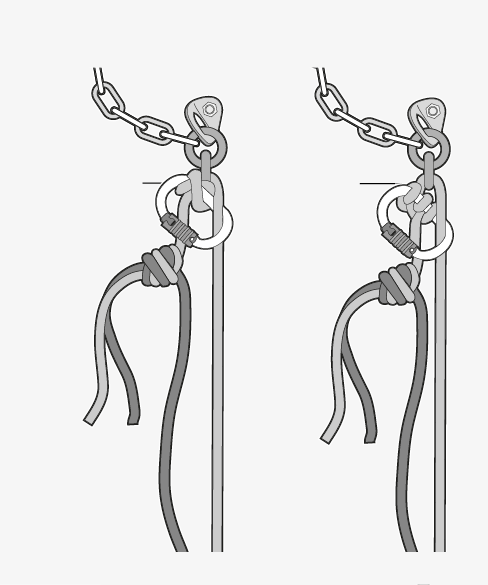
If you are using an ABD such as a GriGri, learn how to use a rope-blocking technique so you can rappel on a single strand. Something as simple as clove-hitching a locking carabiner onto the pull strand allows you to set up a blocked-rope rappel and avoid the need for a simul-rap altogether.
If there are three of you, you have a single-rated rope, everyone is carrying an ABD, and the anchor is bolted, there are still straightforward alternatives. Set up a blocked-rope rappel, then tie an Alpine Butterfly in each strand and clip both loops to the anchor with locking carabiners. This allows two climbers to descend simultaneously on independent strands while the third remains at the anchor. The last person then removes the locking carabiners, unties the Alpine Butterflies, and follows behind.
Again, the point is not that there are no alternatives to simul-rapping. In many situations, there are several. The point is that climbers often default to simul-rapping because it appears simple and fast, when a little more thought, skill, or patience can achieve much the same result while providing considerably more flexibility and a larger safety margin.
Conclusion
There’s a lot to think about in this piece, and there should be. Simul-rapping deserves far more consideration than it is given when viewed as some cool, rock-star method of descent.
I also think the idea of murder-suicide is worth considering in this context. Often, the more experienced—or apparently more experienced—climber leads the less experienced astray, giving them the impression that this is the way, when in reality it may simply be the way to an early death.
Or perhaps it requires no thought at all:
Just don’t do it.
Links:
Simul Rappeling (American Alpine Club)
For Safety’s Sake, Don’t Do This: Simul-Rappel (this is behind a paywall, but having known Rob, I’m sure it’s good).