
Raising Kids
Tom Evans makes me reconsider taking kids up El Cap

My son, Noah, who turned five this week, has a cutting problem—his fingers sliced and diced here and there. The other night he came in from the garden, where he likes to roam in the dark with a torch before his bath—white light, blood on his hands and face, a little shock. His problem isn’t psychological or about mental health, or a cry for help or attention, but one of tool mastery. Each cut is a lesson in how to handle the penknife he got for his birthday. Most parents wouldn’t give a five-year-old a penknife, me included, and those who would would likely take it away after the first cut. For the few who wouldn’t—including his mother—it’s not that they don’t care about the cuts, the pain, the blood, the white shock; not that they don’t love their child or want to protect them, but the opposite. It’s what they believe is best. Others might disagree.
My friend Tom, who takes photos of El Cap, jumped into the “how to raise kids” debate a few weeks ago when he posted this:
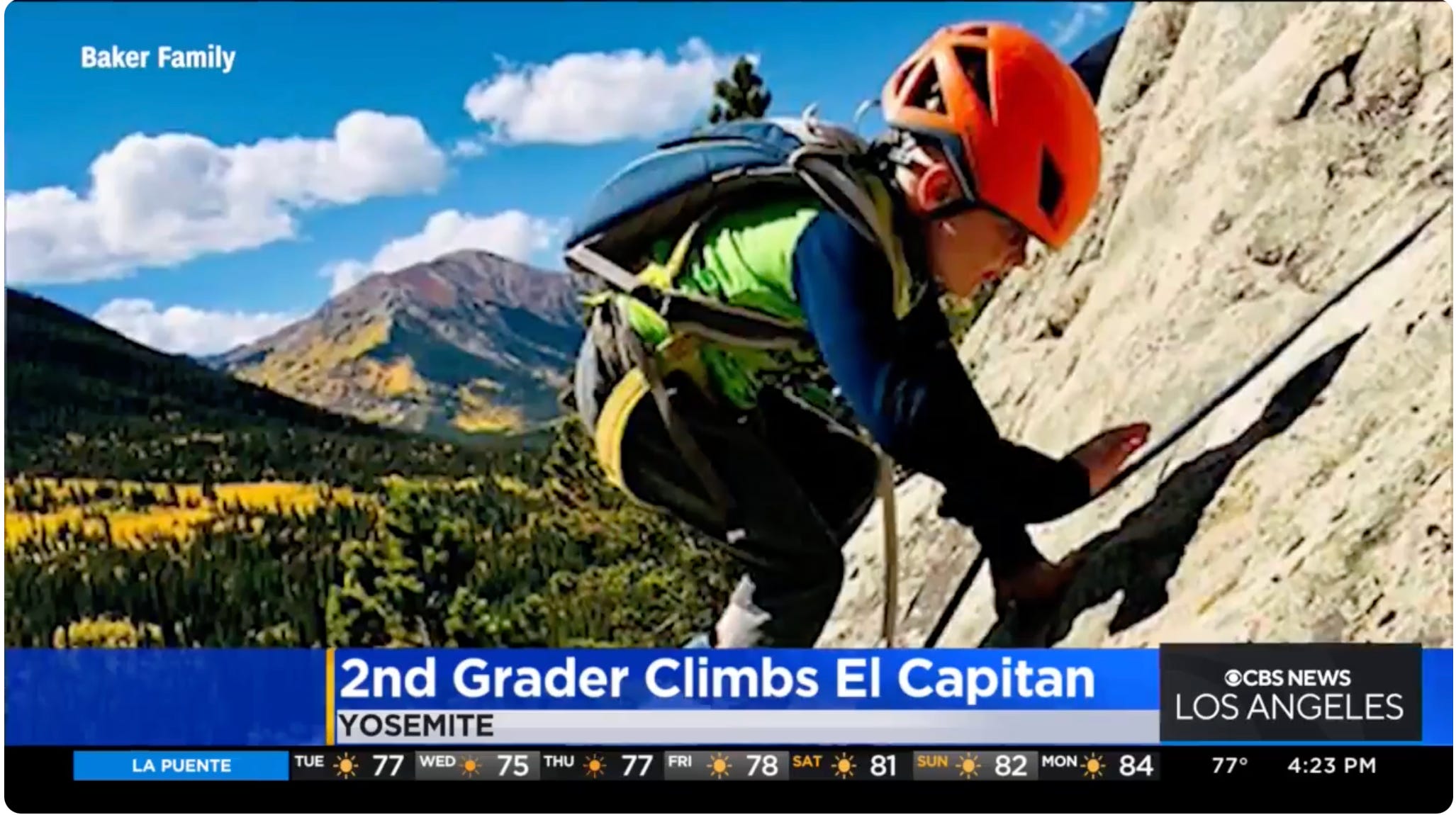
I see that the same people who perpetrated the scam of having a child supposedly “climb ElCap” are back at it again. They have already sprayed in the media about this “climb” tying the (fake) record the brother supposedly set. The brother of the child who was dragged up by guides a few years ago is now to be dragged up like his brother was. This scam is just for publicity and making $$$ for the family. Ascending ropes hung by guides is not “rock climbing” — it is rope climbing and not in any way a climb of ElCap. These parents are just seeking fame and fortune and the kids are just pawns in their greedy hands. It takes a great many skills to climb ElCap and these kids have none of them. A monkey could be trained to climb a fixed rope in a few hours. These children are doing nothing to contribute to the climbing and are just passengers being towed along. 8-year-olds do not belong on ElCap. Some 35 or so real climbers have been killed on ElCap in the past and to take a child up there is simply child abuse. Do not support these scammers. Last week we had a pregnant woman climb the Nose… so I guess her child, in the womb, is really the youngest to “climb” ElCap?????
This statement, from a man I respect—our big-wall Walter Cronkite—felt on the money, but also personal. I was one of those dads who took his child up El Cap, climbing Tangerine Trip with my 13-year-old daughter, Ella, in 2012 (story here). To make it worse, we did it for a BBC children’s program, and for a while, it seemed we’d broken some arbitrary record. And so, when I read his words, it made me think again, as I have since 2012, about what I did back then—my motivations and rewards—and whether it was the right thing to do.
Was it about Ella, or was it about me?
In my defence, social media as we know it was in its infancy in 2012. No Instagram or TikTok. YouTube was still a place for music videos, cats playing pianos, and people falling down holes (Gangnam Style went viral that year, which was the shape of things to come). There were no “influencers,” and celebrities were limited to music, film, and TV. Facebook had a third of the traffic it has today. People didn’t “create content”—they made TV programmes, films, music, did stand-up, or wrote books and magazine articles. Phones had cameras, but the videos were of poor quality, and with 3G networks, there was little point in sharing them. Such has been the exponential pace of change, it might as well have been 1912.
The climb came from a film project that fell apart and was repitched to BBC Kids TV at the eleventh hour—mainly because I’d told Ella for as long as she could remember that I’d climb El Cap with her when she was 13 (she’d sat through plenty of my slideshows as a child, and that question of “when” was often asked). The idea was that TV involvement might cover her flight, but in the end, the BBC made me pay for both, fearing a “child protection” backlash—it was, after all, the post–Jimmy Savile BBC. They didn’t realise we’d actually climb El Cap and thought we’d just walk to the top.
We chose Tangerine Trip over The Nose, which other “kids” had climbed, because it was steeper, safer, and had no traffic. And it was.
It was a great climb, though not easy—very hot, and I ended up hauling for a team of five. But Ella was amazing. She took it all in her stride. She wasn’t treated as baggage, or a passenger, or the MacGuffin, but as a member of the team.
That final evening on the summit remains one of my life’s centrepieces: Ella asleep on the summit, her head resting on a tin of Beanie Weenies. Funny what sticks.
Later, Ella showed her grandmother (not my mother) the BBC film. It had a big impact on kids in the UK—parents told me their children watched it again and again. It inspired some to start climbing. One girl even asked her mum to buy her a harness so she could sleep in bed wearing it, pretending to be in a portaledge like Ella. A Norwegian friend explained why kids loved it: modern TV is “about people finding easy things hard, not hard things easy.” Everything was about fake drama. Lazy on the brain, like sugar. And Ella had found it easy. She was the kind of role model kids really want, but rarely get, in a culture that seems to fetishise weakness, difference, and vulnerability. If there’s nothing wrong with you, and you’re well-adapted to life, maybe even a little fearless of it, you’re of no interest to TV producers. They just want drama. Maybe this is why we have a generation that feels nothing unless it’s anxiety. Now, if you’re not divergent, you’re made to feel like nothing.
Her grandmother, mean as a wicked stepmother, said only, “She just climbed the rope?” Which was true, and Ella always admitted it. My defence, because she was my daughter, was: “Neil Armstrong didn’t fly his rocket to the moon, but he still sat in it. And he went to the moon.” I’d have loved to transport her grandmother to a free-hanging rope seven hundred metres above the ground and see how easy it was not to freeze and burst into tears.
Yes, I made some money from climbing El Cap with Ella—I included it in slideshows—but I did that with every trip. I also gave free talks at schools about the climb, so I hope I gave something back.
Fast-forward to 2025.
I understand any criticism from Tom now, although back then such things were rare. It would be impossible not to get sucked in by social media. To lose your grip on your climb, your child, yourself. It’s not easy to turn down requests from journalists and TV people for interviews, but the more you do them—and the more you realise it’s really no better than an undertaker measuring you up—the easier it becomes.
I hope back then, Tom could see it was genuine, came from a good place. The BBC part—just something creative, not commercial.
But now, in this world of content creators, viral fame, and instant obscurity—like last year’s must-have now gathering dust on a charity-shop shelf—things are different. Maybe it’s less about raising a child up a big wall and more about raising one’s own stock. I don’t know. If you’re American, maybe that is the dream. Everything online has the potential to make money these days—whether it’s showing your genitals or your kids. It’s how young people are conditioned. We boomers and GenX’ers were all about the internet as the commons, giving it all away for free. Now, the Zoomers always be closing.
I’ve met a few celebrities in my life, and I can tell you—fame, even the smallest whiff of it, is nothing a parent should wish on their kids. It eats your soul.
Some competitive pressure, some reality—winning sometimes, but mostly losing—is vital in a child’s development. Protecting them from this, the medals-for-everyone mindset, leads to problems later. Life is mostly losing. But the competitive pressure of fame and social media burns out most adults, so what chance—or damage—does it give a child?
When my wife shows me a viral video of a child doing a hundred pull-ups—built like an Olympic athlete—something in me stops before I think it’s cool. It’s too polished, too well-edited and cut. Someone’s directing this, and it’s not the child. Having a kid that strong would be great, but filming it, posting it, becoming their coach, manager, Stromboli—can that be healthy? Google “child actor.” Something changes in the relationship. I’m sure the parent jugging beside their eight-year-old, filming and live-streaming as they jumar the Nose, wouldn’t see themselves as a pushy pageant parent living through their child. Maybe they’re better. Maybe they’re worse.
But in defence of kids climbing and doing risky play—would I prefer a world of four-eyed, screen-glued children, detached from the living, full of fear and anxiety, afraid of everything, mostly themselves—or a world of YouTube child influencers free-soloing El Cap? Really, you don’t want either.
A child is like a block of marble. If you only polish and care for it, it’ll never be more than a block. If you kick it and abuse it, it’ll become a misshapen lump of nothing. For it to take shape, it needs to be hammered and chiselled—with care, and whatever skill you can muster. Hopefully, after six or so years of constant work, you end up with something of human shape, an amalgam of imperfection and hope. Then you hand it to others to take a bash.
So, I can see Tom’s point, like I didn’t in 2012. If it were now, in this world, I think I’d still climb El Cap with my kids—and maybe I will again one day. Only next time, I’d do something really noteworthy, and keep it to myself.
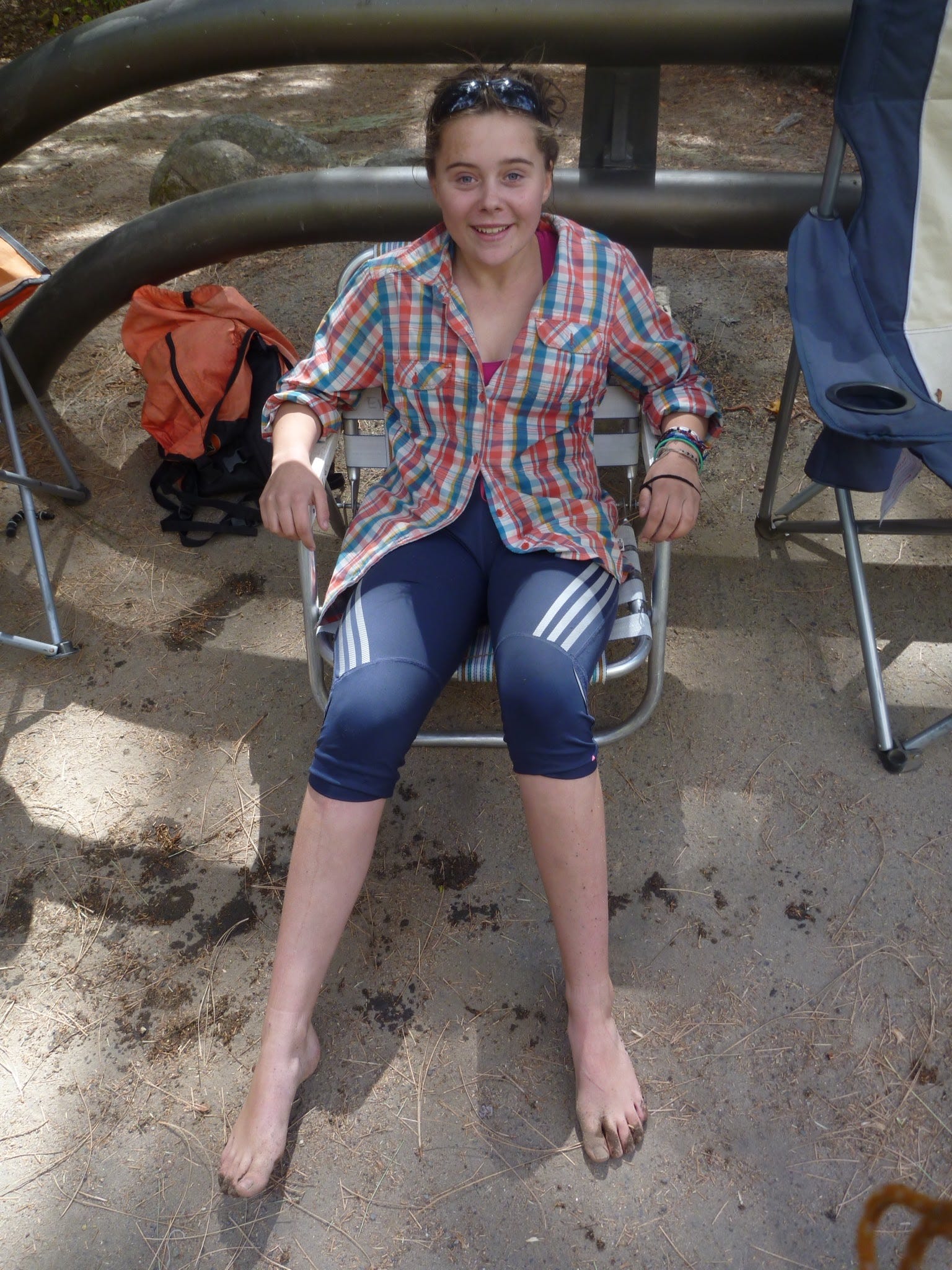
As for Ella—when we finished our climb and got down to the bridge, where Tom takes pictures, he said, “Ella, you can now sit in the El Cap chair,” a ragged camp chair by his van. As she sat there, grubby like few 13-year-old girls ever are, Steve Schneider came over and told her she was now the youngest girl to climb El Cap*—which he should know, as he’d guided the previous record holder. I saw Ella fill with pride, which, as her dad, I knew needed pricking. I said, “Ella, it doesn’t matter who’s the youngest. You were just the youngest person with the opportunity to climb El Cap. What matters is what it means to you. Nobody else.” I saw her deflate, then process it, her feet settling on something firmer.
Ella is now 27. After the climb, she passed through her teenage years untouched by the usual storms—no self-harm, no eating disorders, no bullying, no bad photos, no suicide attempts. Just impatience to get on with life. At school, she was “not that good at maths,” yet went on to earn a first-class maths degree at Leeds, started a successful tutoring business during lockdown, then became a data analyst in London, and now runs a team. I’m not saying any of this was the result of climbing El Cap, but I do think it reframed what was possible, with a bit of grit and determination. If anything worries me, it’s her drive, which can become like a runaway engine—but I’m sure she’ll figure that out.
Oh yes, back to my son’s cut fingers. Fifty years on, I can still see scars from my own childhood—a fingertip sliced by a scalpel, a thick scar from riding my bike into a wall, a hole in my knee from barbed wire meant to keep kids out of a great climbing tree. Each scar, each pink line, is a lesson not forgotten. The harm isn’t in the cuts. That kind of pain is so short-term it might as well be a tickle. The harm isn’t in cuts, scars, or pain, but in perfect, unblemished, porcelain skin—children, doll-like, never given the chance to escape their box.
*In the end, Ella wasn’t the youngest. The previous record holder, now an adult, emailed her to set the record straight—she’d been a few weeks younger. I guess it was another time.
Hi Andy - I loved reading this. Really resonated with me. Both the way that my parents brought me up and how I have “subjected” my two to the mountains. My son recently finished his a-levels and he and I spent two weeks on Skye and did the Cuillin Ridge traverse together. Felt like the ultimate culmination of our time together through his childhood. Seeing how moved he was as we stood on the In Pinn watching the mid-summer sun set or on Sgurr Dearg with a cloud inversion was tremendous. He’s gone to university now and the first thing he did was join the climbing club. Of course I am proud of him in general but, as it relates to the outdoors, I am just overwhelmingly pleased for him that he has found the joy of being out there and pushing himself to find those moments. Thanks for your article. Marcus
Thanks for sharing. I wonder what you'd think of Reagan_Rocks_Rides (on YouTube & Instagram).