
The Silent Killer
Revisiting a 2012 article by Paul Ramsden.

I think this article has some important messages, so please consider sharing it.
In 2012, Paul Ramsden wrote a piece in the Alpine Journal science section called ‘The Silent Killer’ on the subject of carbon monoxide (CO) poisoning in mountain climbing, a piece of indepth work that should have been picked up far and wide, as its conclusions - or redescoveirs - could save countless lives, as well as innumerable cases of CO poisening mascarading as ‘altitudfe sickness’. Paul believed that many high altitude deaths, or strange ‘sudden death’, were not altitude-related, such as heart attacks and strokes, but caused by improper cooking inside a tent (you don’t cook outside your tent at the South Col!).
I expect many would have missed Paul’s article, tucked away in an obscure journal, a bit like how most people miss Paul, who, although a man who hides his light under a bushel, currently holds more Piolets d’Or’s for high altitude climbing than anyone else alive (I think he has six?). The fact that he has no sponsors and buys his own boots, etc., shows that, for Paul, climbing is more a trade or a monastic pursuit than a path to fame and fortune. Paul put the work in to make us safer; it was up to us to find it and read it.
One other reason why Paul's words have real meat to them, beyond decades of experience in the mountains, is that Paul is also a world expert in toxic gas hazards, meaning he was uniquely qualified to produce such a piece of work, but also not the ideal person to inform anyone of his findings. This is where I come in.
Although I only have a fraction of Paul’s experience in the mountains (I have no Piolets d’Or’s on my mantle, or a mantlepeace), and zero knowledge of toxic gases beyond dealing with babies’ nappies, I do know something about getting the word out, both to unrich myself (please subscribe!), but mostly, to keep fellow climbers alive and well.
Although fourteen years late, I hope this piece helps get Paul’s main points across.
Why CO Should Scare You
If you’re into mountains, polar trips, or just winter camping, you’ve probably heard the basics: carbon monoxide is a killer. The first time I found this out was reading Martin Moran’s Scotland’S Winter Mountains (recommended), in a section about almost asphyxiating in a snowhole (“must avoid that!” my young brain thought). You learn early on that CO is an invisible, smell-less gas that sneaks up on you. One minute you’re fine, the next you’re unconscious, then you’re dead. It’s easy to put this into the ‘how other people die, not me’ category of things people die of, like ‘eaten by a great white shark’ or ‘lightning strike’, but death, or near death, is nearer than you think.
Although a killer and a clear and present danger anytime you’re cooking, most of us don’t really understand the process of our demise, or how to avoid it; we think we do, but the moment we start to nod off, or our head starts to pound, we realise we didn’t.
CO 101
First, every camping stove produces CO, whether it uses petrol or gas, or charcoal, sometimes a lot, sometimes less (a disposable barbecue gives off 100 times more CO than a gas stove, which is why they kill many campers who try to use them to heat a tent or van).
CO is super common in “normal” life — think faulty heaters or car exhaust — but when you combine this CO gas with a confined space, reduced oxygen, such as at high altitude or in a snow hole or tiny tent, what could be a headache-level dose at sea level can kill you.
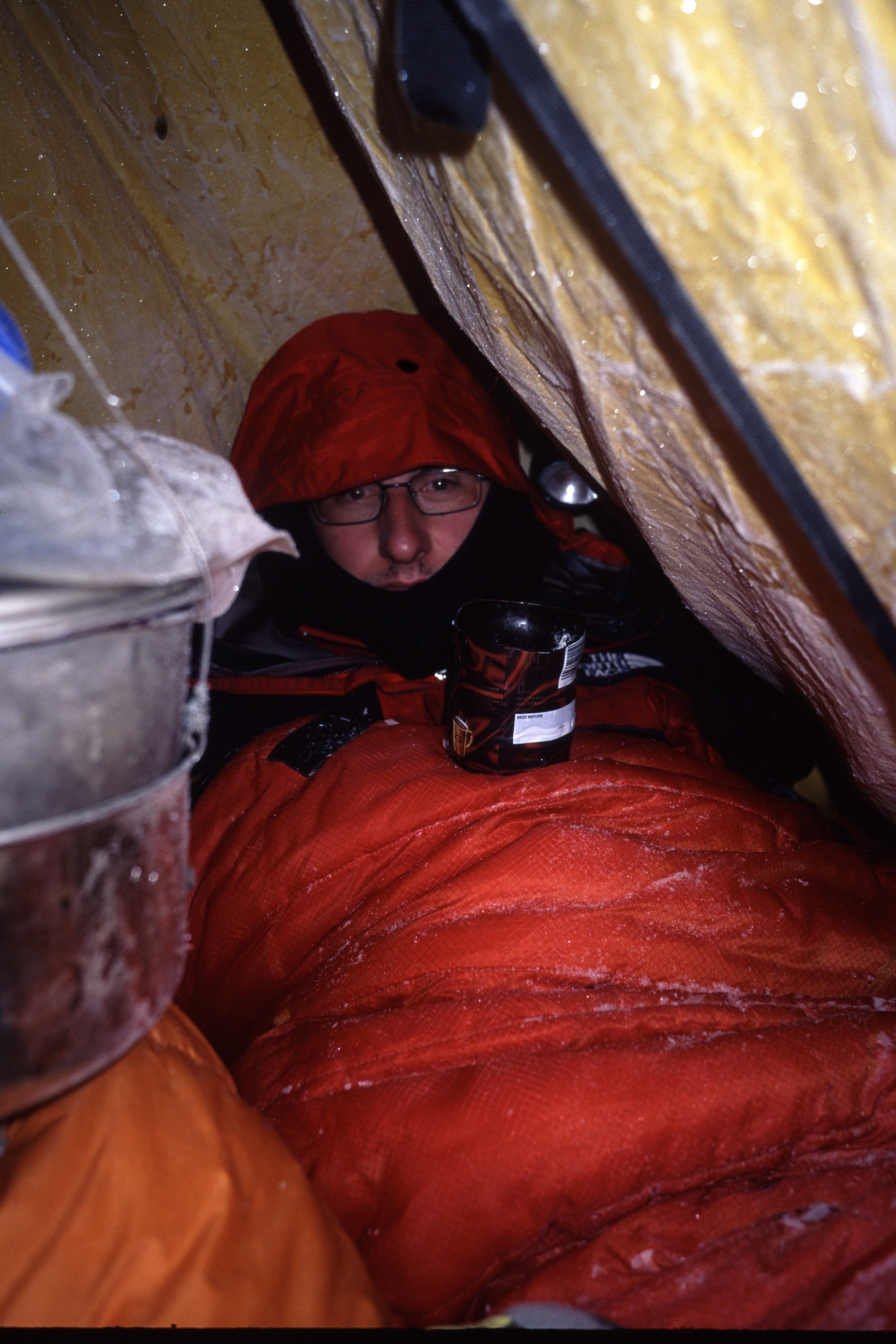
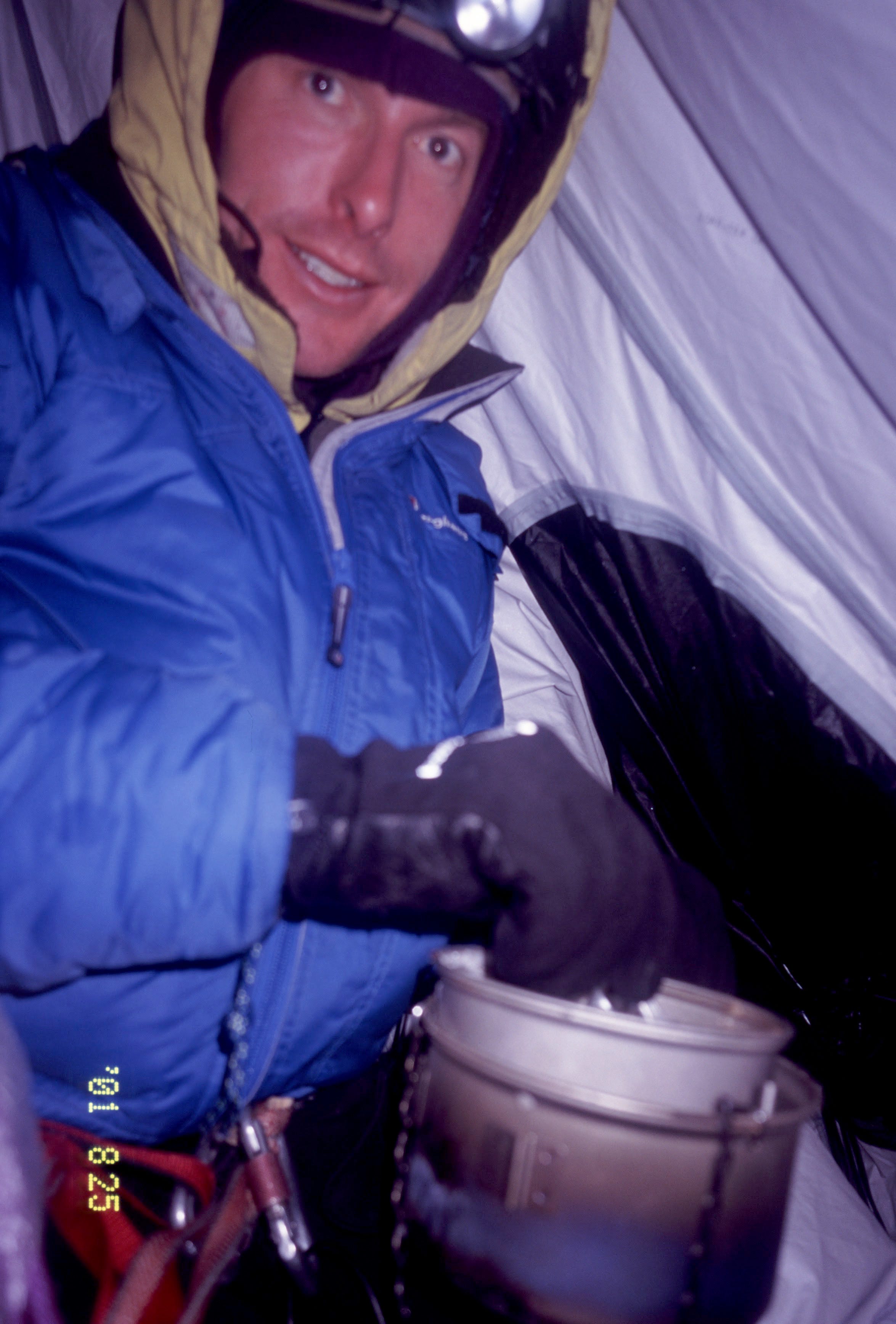
Paul had multiple run-ins with CO over the years, especially in his early days working as a field assistant in Antarctica, where he would spend weeks at a time trapped in small two-person tents, forced confinements he’d experience later in Alaska, or on small sitting bivies, cooking under a bivvy sack. He’d experience brutal headaches, dizziness, nausea, and near-blackout, but also - and more important to grasp - feelings of depression and mania. CO exposure had been messing with the brain for decades.
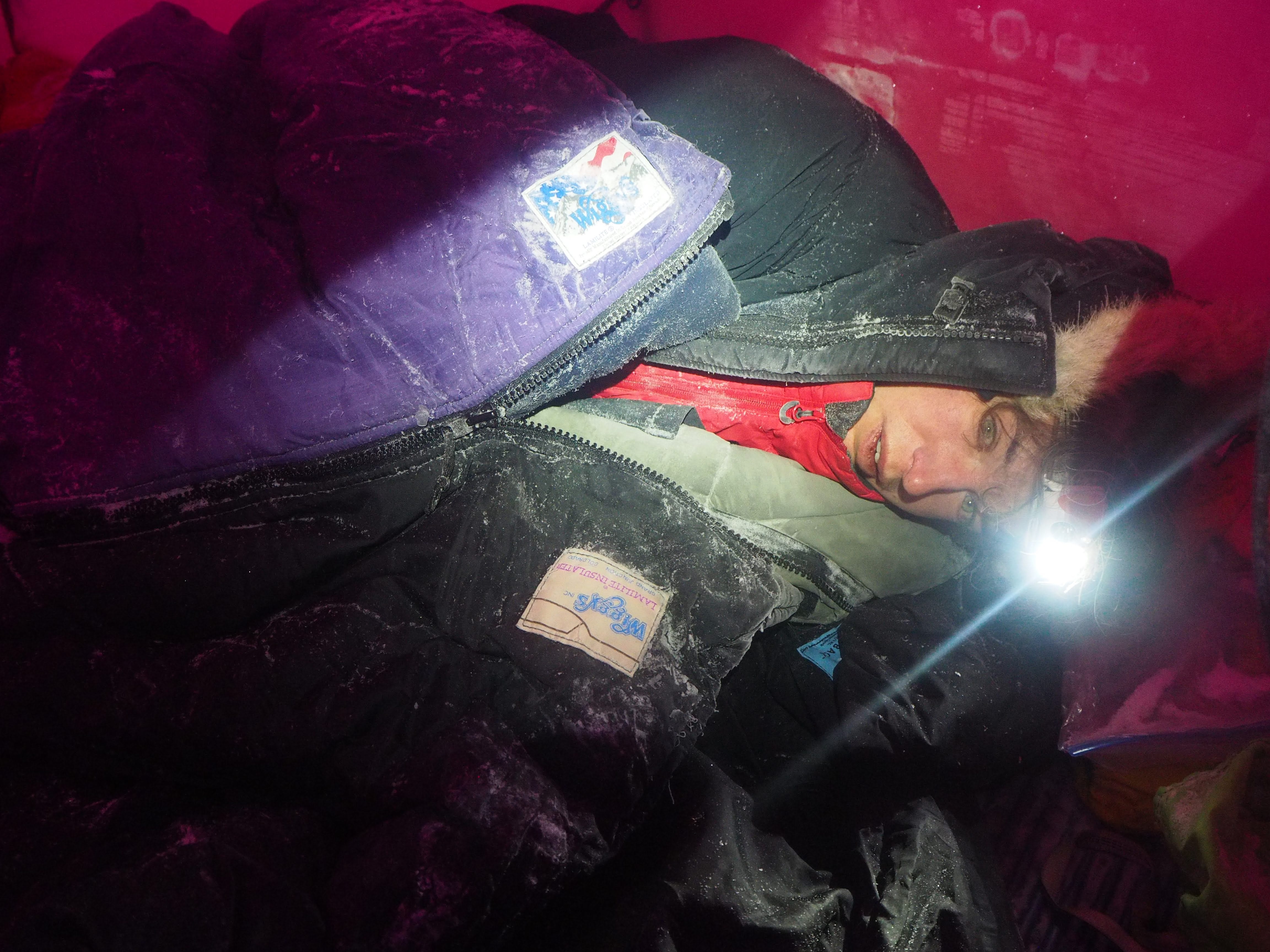
I’ve had similar experiences, and cooking under a non-breathable portaledge flysheet for days on end is a great way to kill yourself, taking that sudden little nap while the tea cooks. I’ve also spent weeks, well, months, living in snow holes, often snow holes with no ventilation.
The breaking point for Paul, where we really needed to understand the process of mountain CO poisoning, came about due to the groundbreaking introduction to super-efficient stoves like the Jetboil and MSR Reactor, which, although a gift to all climbers, was also a potential killer, pumping out far more CO gas than traditional stoves. Paul noticed the effects of CO more clearly when using this stove style, which led him to test stoves as he would any machine or contraption that could harm its operator.
How Stoves Actually Make CO
All mountain stoves burn hydrocarbon fuels — propane, butane, white gas, paraffin, whatever. When they burn cleanly, you get mostly CO₂ (carbon dioxide) and water vapour. But combustion isn’t always clean, as ‘clean’ is often secondary to speed.
Heat cracks the fuel molecules apart. First, you get carbon radicals, then acetylene, free hydrogen, and loose carbon atoms. Those carbon atoms grab oxygen to form CO. With enough heat and oxygen, CO grabs another oxygen and becomes CO₂ — burning blue and hot.
The problem hits when the flame gets cooled or starved of oxygen. That’s “quenching.” Anything cold touching the flame — like the bottom of your pot, fins on a heat-exchanger pan, or even tent fabric — sucks heat away. The flame drops below the temp needed to finish the job, so CO escapes instead of turning into CO₂.
Free-burning flame (no pot)? Minimal CO.
Pot sitting right on the flame? Way more CO — sometimes 100x more.
Bigger pot or one with fins (Jetboil, MSR Reactor style)? Even more quenching, more CO.
This isn’t new info. Back in 1940, a Nature paper noted that when a flame hits a kettle, it cools and spits out CO. Another 1942 paper from Alaska talked about melting snow with stoves producing CO. But few took any notice, the focus always on “how fast can I boil a pan of water”, and that’s it, with no one ever asking “how quickly could this kill me?”
Most real-world chat these days happens on forums like Backpacking Light, where folks like Roger Caffin did tons of hands-on testing, but beyond that, it’s a bit of a dead subject, perhaps becouse manufacturers, like MSR or Primus, don’t want to project the image of a stove being a potential killer, and would rather just tell you - unhelpfully - to cook in well ventiled area (ass covering really).
Altitude & Environmental factors
High altitude and cold climbs make everything worse:
Thinner air = less oxygen for clean burning → more incomplete combustion → more CO.
You breathe faster to compensate → suck in more CO if it’s around.
It’s colder and windier → you zip the tent tighter, block vents with snow/ice → CO builds up over hours.
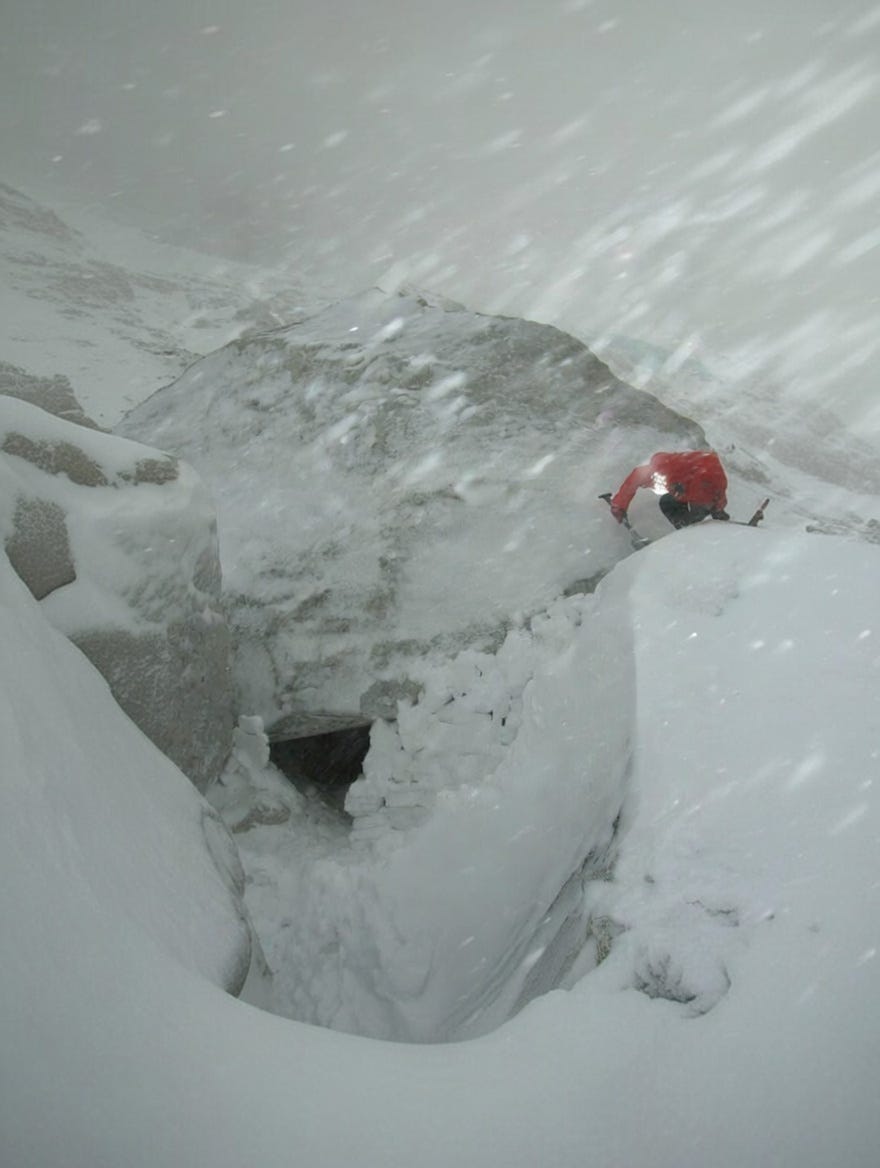
The primary reason for ‘digging your tent out’ is not to protect the tent, but to rid your tent of CO gas when cooking.
Snow holes have some capacity to ‘breathe’ when fresh, but some turn into tombs once the walls freeze up, and entraces become buried.
What CO Does to Your Body
CO is called the “silent killer” for good reason — no smell, no color, no warning. It binds to haemoglobin (the oxygen carrier in your blood) about 210–250 times stronger than oxygen does. So it hogs the seats on the bus, leaving your brain, heart, and muscles starved.
Early/mild symptoms (easy to brush off as altitude, fatigue, or flu):
Dull, constant frontal headache (most common first sign)
Nausea, feeling generally crap
Dizziness, fatigue, weakness
Confusion, irritability
Worse stuff:
Fast heartbeat, low blood pressure
Hallucinations, unsteady walking, seizures
Unconsciousness, coma, death
Even scarier: delayed effects can hit days later (up to 50% of cases). Memory fog, depression, dementia-like issues, Parkinson-ish tremors, speech problems. Old studies show headaches can start around 35–100 ppm exposure; 200 ppm messes with judgment; 300+ can drop you; 1600+ kills in under 2 hours.
At altitude, your lungs already struggle with lower oxygen pressure. Even modest CO (say, 9–19% carboxyhemoglobin in blood) can make healthy people collapse at ~4700m, while the same might just feel meh at sea level. Faster breathing pulls in more gas, and CO clears more slowly from your blood under low pressure.
A lot of “altitude weirdness” — bad decisions, route errors, fumbling gear — might actually be low-level CO chipping away at your brain, not pure hypoxia.
What Studies Say About Stoves in Tents
Research is spotty, but consistent:
Simon Leigh-Smith’s 2004 review “Carbon Monoxide Poisoning in Tents” pulled together case reports and experiments up to then. Key takeaway: CO is lowest with free flame; it jumps when you add a pot.
Ventilation matters hugely — poor airflow (snow-blocked vents, no wind) lets CO pile up.
Bigger pans = more surface quenching = more CO.
Paraffin fuels are often worse than others.
In poorly ventilated areas, even blue flames can mask high CO levels.
Paul’s own tests (on Primus stoves mostly) showed that any object in the flame zone spikes CO massively. Modern efficient systems? The fins and close contact that save fuel also quench harder.
Recent stuff backs this up. Tests on popular stoves (Primus Power Trail, Jetboil MightyMo, MSR PocketRocket) show they all produce CO inside tents, but rates vary. Heat-exchanger designs like early MSR Reactor prototypes cranked out over 1000 ppm at low power (scary!). Manufacturers tweaked things, but the principle holds: closer flame-to-pot contact increases the risk of CO.
Real-world reports: dozens of deaths yearly in the US from stoves/lanterns in tents/campers. Many in enclosed spaces, some at altitude where risk skyrockets. CPSC (Consumer Product Safety Commission) warns never to use fuel-burning gear while sleeping in tents.
A while back, on my podcast, I talked about running a petrol stove sans pan to warm a tent, a technique that is common in Arctic travel, where the stove is often brought into the centre of the tent, the heat used to dry the tent and clothing, plus give a psychological break from the clawing cold. I had used this technique many times, in tents and portaledges, and never had a problem, as the flame was not inhibited in any way. But then I had an email from an ex-Royal Marine, who told me how some soldiers had died out in Norway when using this method, but had failed to keep their stove pressureized, which led to a less efficient flame, higher CO, and death.
Practical Tips: How to Not Poison Yourself
Ditching your stove is not an option, especially not a game-changing fancy stove, where fuel savings on long trips are massive (half the canister weight, stay out longer), but rather, like any life-saving, but life-taking machine, you need to know how to use it safely.
Cook outside whenever you can. Get yourself a high-quality silicone tarp and learn how to use it (once you do, you’ll wonder how you did without it). Cooking in a vestibule with the door wide open is second-best, and this is one reason why extended porch tents are by far the best tents you can use for long-term camping.
When you can, ventilate like crazy inside when cooking. Keep vents/doors open. Snow or frost can seal “breathable” fabrics — check and clear them.
Don’t fall asleep cooking. Nodding off is how most bad poisonings happen.
Watch the flame. Yellow/orange = incomplete burn (more CO). Blue is better, but not foolproof in enclosed spaces.
Take symptoms seriously. Headache, dizziness, confusion? Get fresh air fast. Assume it could be CO, not just altitude. In my experience, CO effects do not come in some set order. People can be OK one minute, not OK the next. Others will begin to feel breathless, while others will begin to get a headache, while another person is fine.
Portable CO detector — small ones exist now (battery-powered, backpack-friendly). Cheap insurance.
Lower power settings can sometimes increase CO on some stoves (less heat to complete combustion), so keep stoves fully pressurised (I’d love to see MSR bring out a pump that features some kind of gauge).
Wind and cold push you to hunker down — that’s when risk peaks.
So far, none of this is too groundbreaking, and much of it is common sense. The next bit is less so.
The CO gap
A real killer tip from Paul’s research was that by elevating your pan just a few centimetres above your flame, you could significantly reduce CO, as you allow more space for the gases to be burnt. This CO gap is unnecessary when using a well-ventilated stove; the current gap is fine-tuned to achieve the best balance between combustion and heating speed. But when you are forced to cook in poorly ventilated or low-oxygen environments, that CO gap could be the difference between life and death.
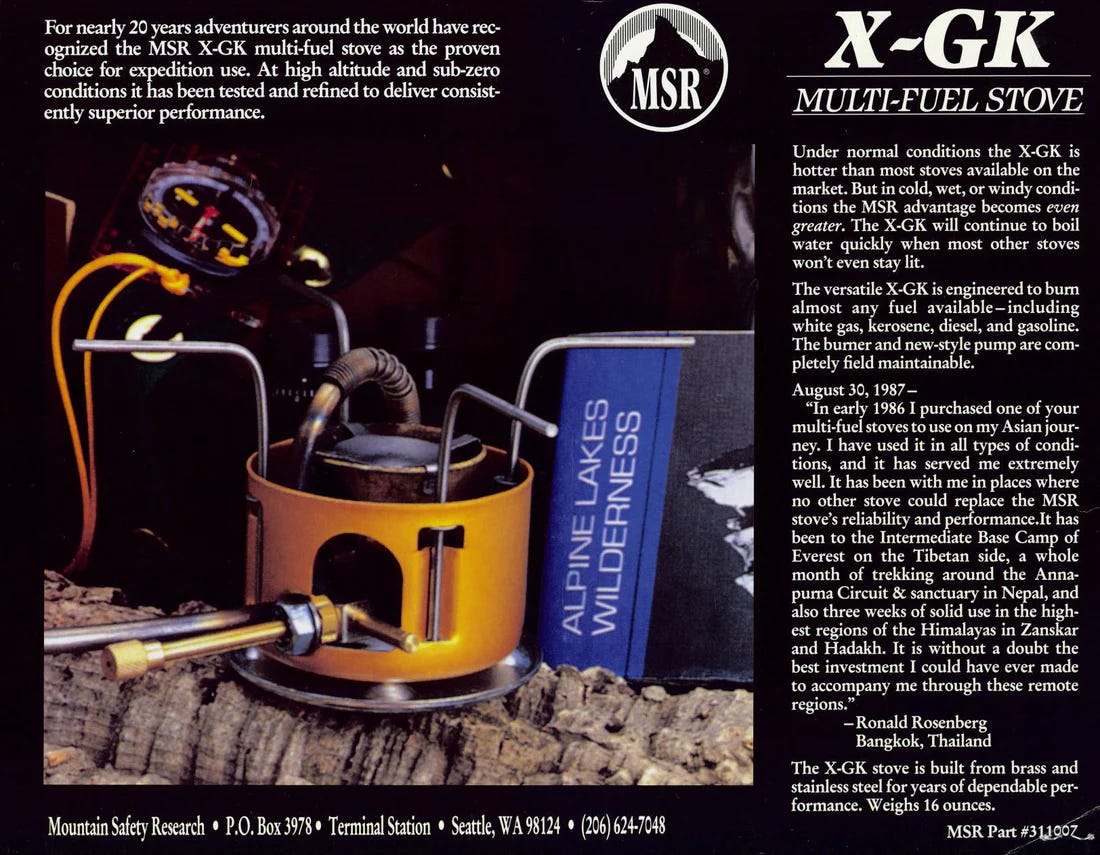
What is remarkable about this discovery is that it wasn’t a discovery at all; it was a rediscovery. Up until the 90s, a top-end mountain stove, like the original MSR XGK, came with two sets of legs, summer legs (short) and winter legs (long), and I expect the same was true of other stoves; this option was something even Nansan would have understood a hundred years ago. The reason such vitally important details or accessories disappeared was probably becouse people just forget what they were for, a perfect example of Chesterton’s Fence. Or maybe, companies could save a few cents by leaving them out. Whatever the reason, they disappeared.
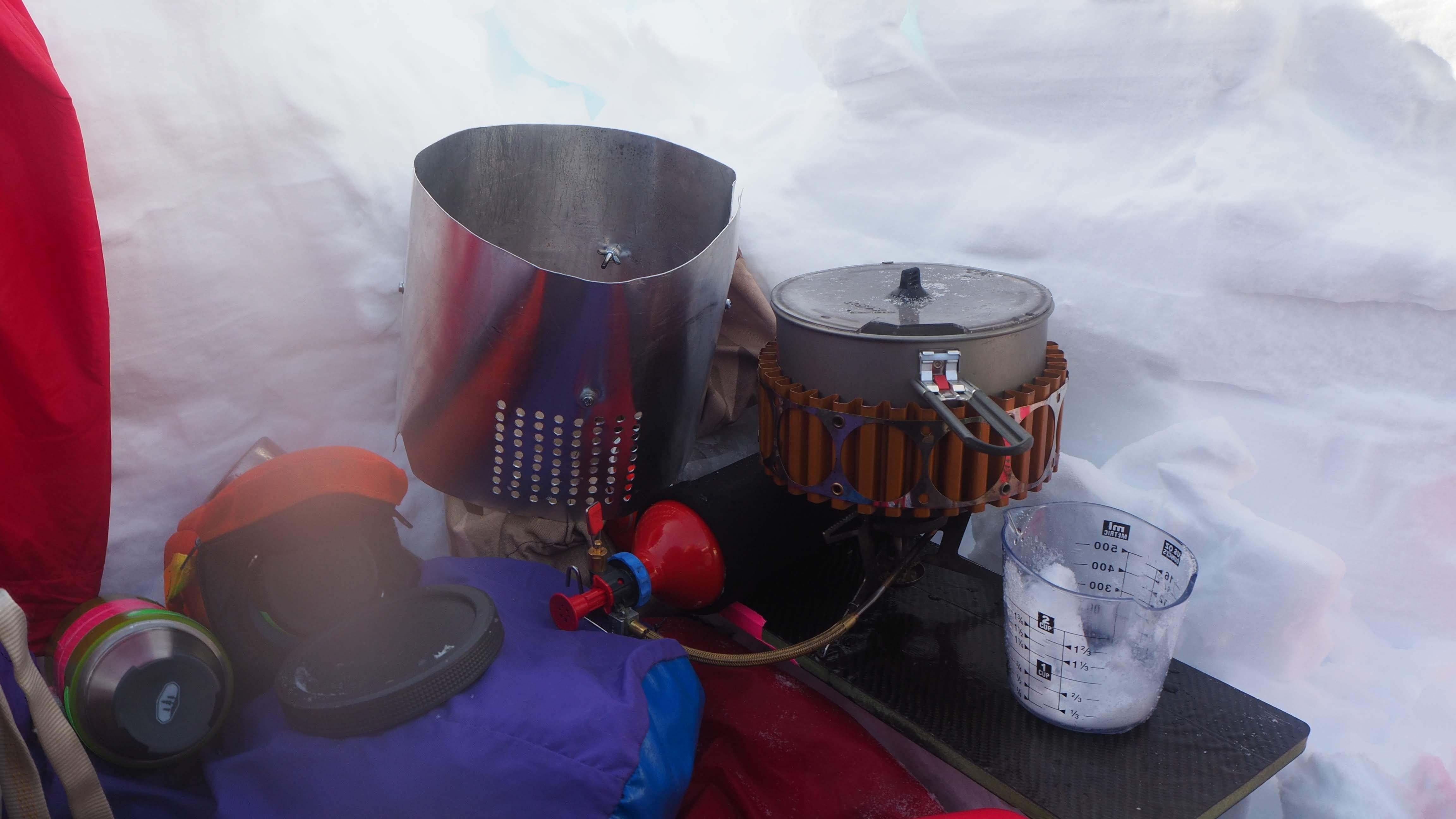
For me, this was a real game-changer, and I redesigned my petrol hanging stove (MSR Dragnonfly bolted into a steel pan) so the stove pan was 3cm higher than it would be. Yes, I probably added a few extra seconds to the boil time, but that’s not a lot when you add a few more decades to your life.
More importantly, I built a windsheild for my MSR Whisperlite out of alloy sheeting, which gave me more space above the stove, which I then used for seven weeks straight on Denali. Most of the cooking was in snowholes or snow pits, generally completely sealed off from the outside, often for a week at a time. We did not have any problems with CO. At the time, I thought that maybe there would not have been a problem anyway, as I was always careful to keep the flame hot and limited cooking to a minimum (we only put the stove on once a day, and used flasks for the morning). But when we climbed up to the last camp at 17,000 feet, I just took the stove sans windsheild, and on the morning we were going to go for the summit (the temperature was -50 deg C at 3 am), Vanessa got CO poisoning, hallucinating that she was falling into space. This was less than optimal when there was no chance of rescue, and we were the only two people in the entire Denali mountain range.
All I could do was turn off the stove and allow her to recover. Although CO is 3% lighter than air, I wondered if at 17,000 feet the CO would sink, and so have an effect on Vanessa, who was lying down, while I was propped up on my elbow. Also, maybe women are more easily affected by CO. Who knows, but that was it for us, and down we went.
This experience taught me that anyone on a long trip, whether in tents or snowholes, or at a fixed-base camp tent, should consider either making a windsheild that elevates the pan or modifying the pan supports in some way.
Wrapping It Up
CO isn’t some rare boogeyman — it’s chemistry doing its thing when conditions aren’t perfect. Every stove can produce it, quenching from pots/fins makes it worse, altitude turns mild risk into deadly, and tents are tiny poison chambers if ventilated poorly.
Be smart: cook outside, ventilate obsessively, stay awake while burning, and listen to your body. The mountains are amazing, but they’re unforgiving if you ignore invisible threats.
If you think the information is of value to you, then please share it far and wide.
I’ll put some effort into sharing it and you with others.
Andy, this is tremendous information. Thanks for highlighting Paul Ramsden’s work and further making it accessible. I’ll share this with others. The Explorer’s Club, among others, can make this even further accessible.
I’ve been following your contributions for years, including your content for rope-soloing, Cold Wars, and Psychovertical. I appreciate your struggle with self-promotion.