
Turtle on the Tempest
El Cap solo guest post special

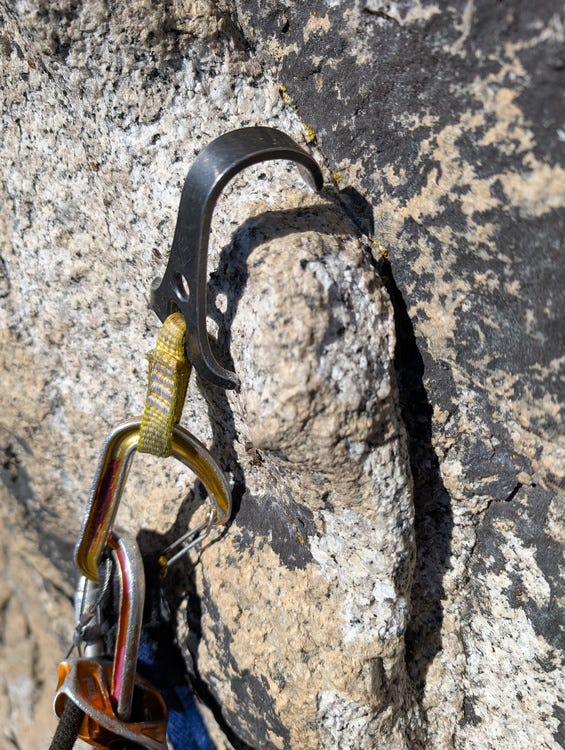
El Cap trip reports are like Mission Impossible films, entertaining, often thrilling, but mostly all just the same. But when I read this week's guest post on Mountain Project, by Adriana Sabella, about soloing The Tempest (A4), and read the words: “I spent a total of 11 nights in that spot”, I knew this was something else, as was Adriana, who, it turns out, is also a relative newcomer to big wall climbing.
It’s a shame when such great stories end up like yesterday’s newspapers, just forum grist, and so I asked Adriana if I could repost it on this Substack. I hope you enjoy it.
I dedicated my November to climbing the Tempest (A4+), on El Capitan. An unanticipated storm rolled in, and I spent 20 nights in the sky by myself. I want to remember everything; it’s hard to condense this into words. Countless crucial lessons, so many moments of beauty. The climbing, the movement, the systems-they were all in sync with my wholly encompassing need to keep moving up. Solitude and time turned physical climbing into the most powerful metaphor for life I’ve experienced so far.
I started this route by fixing one pitch a day, approaching with caution and curiosity. The climbing felt scary, hard, and real, but my desire to find out what was above me consistently won out over my fear. Breathing, singing, making peace with a nest of yellowjackets, learning to hook more confidently and clipping more copperheads than I ever have before came with the relief of touching the ground afterwards. After pitch 2, I took a break to climb Native Son, a pre-existing plan with a friend that fell through after pitch 3. But I got what I needed. The bail was amicable (it felt like it bolstered our friendship), I climbed my first A4 pitch (the crux pitch of NS felt chiller than the Tempest so far, maybe because I had a belay and a friend), and I learned an important lesson about using better ropes (we core-shot both of ours). So–back to the Tempest.
With 4 pitches fixed, I wait out one day of rain while trying to think of all the things I might forget and babysitting my friends’ 5-year-old, which feels so weirdly normal that it helps lessen the gravity of my last day on the ground.
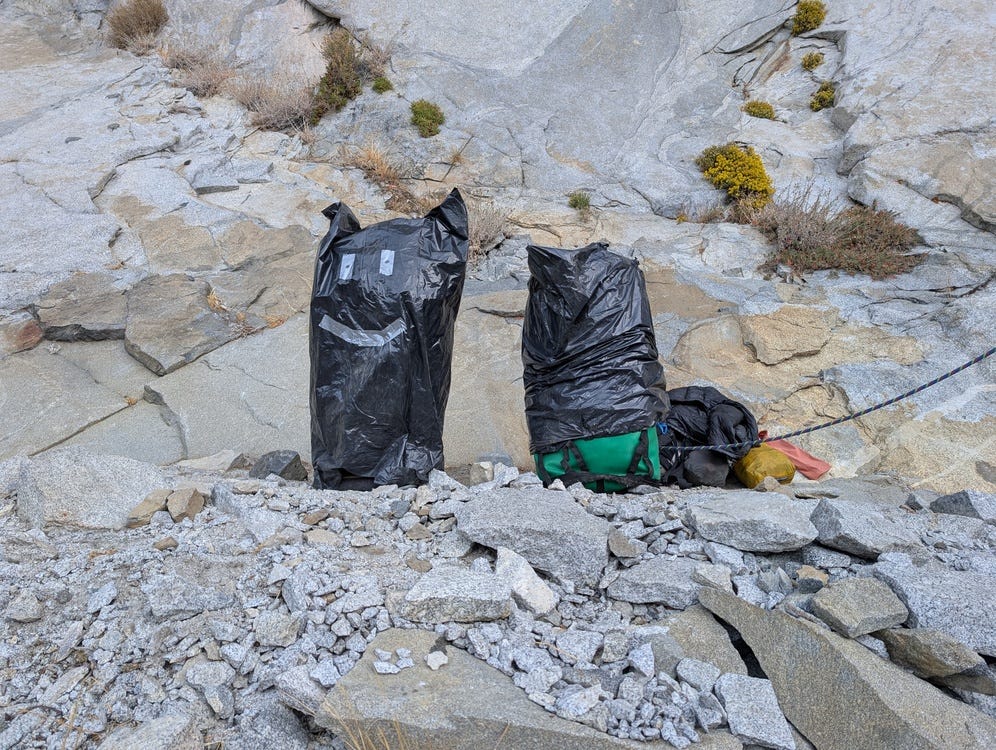
The next morning is fresh, a beginning washed clean by rain. I press both hands firmly into the gravelly dirt at the base of the huge alcove that looms over me, soaking up this last horizontal solidity. I do this every time. Goodbye ground. See you soon. Start moving. I jug up my first fixed line, a free-hanging 70-meter jug, a flimsy, wavering stanchion into the sky. I haul all day, straining against a load that weighs almost three times my body weight.
Memory is a funny thing, diaphanous and unreliable. Now, writing safely from the sunny riverbank of the Merced, I remember- a plan that was executed smoothly, feeling at ease in the portaledge, the Cathedrals illuminated by the almost full Moon. My journal entry belies this. The first day was hectic, exhausting, and strung together. I am quivering with doubts and the efforts it took to haul that much weight, scared to go up and scared to go down, questioning why I’m even up here. The moon is a floodlight in my eyes; I’m too activated to eat, and I can’t get the ledge perfectly flat.
The next morning, I'm interrupted when I drop the stuff sack containing my puffy and charger pack. I sit staring at the winking yellow on the ground, fuming. I pack up and get ready for the next pitch, tie all my ropes together, and float in indecision. Waste precious time and energy, entertain the risk of my rope seesawing on this edge as I’m jugging, or buckle already and call for help? I had paused my messaging apps and set the intention not to talk to anyone while I was up there; I was only going to use my phone to check the weather. I weigh expectation, self-reliance, and avoidable risk against asking for help. My friend once told me he thought I’d rather die than ask for help. I sit there for longer than I need to, and then I phone a friend. 10 minutes later, I see two people on the approach, and I’m able to yell down to them to clip my stuff sack to the ropes, please.
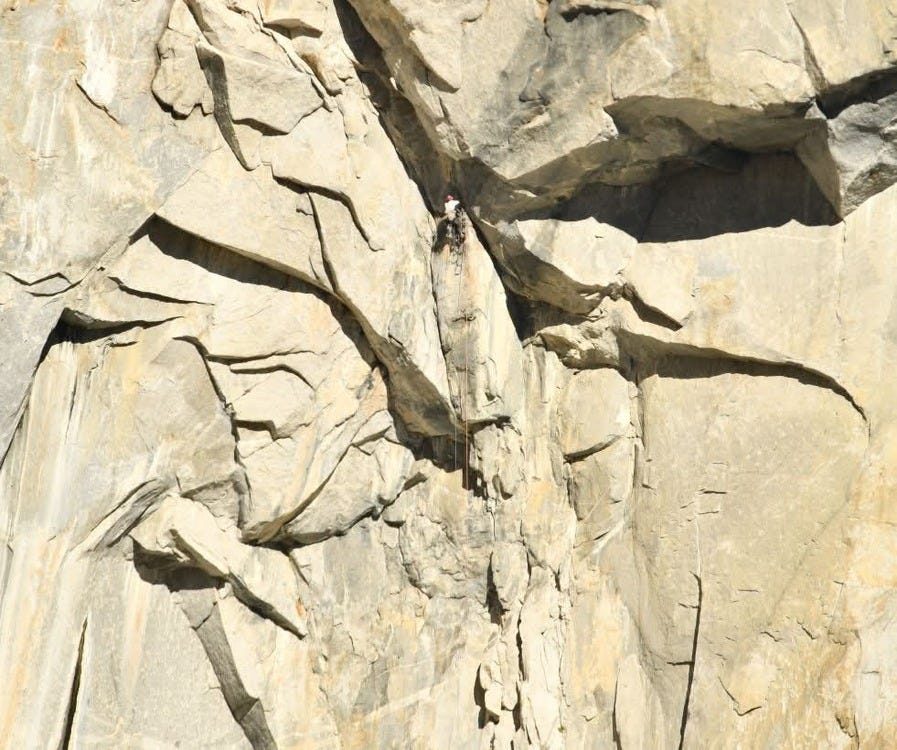
The days are short. Everything takes me longer than I expect. I keep my watch on the old daylight saving’s time, get up early every morning and am caught and devoured by the dark every night. I switch between a 2:1 and a 3:1 hauling system, but my bags are an anchor, and time is slippery. The climbing is tricky, scary, thoughtful, and reachy. The wall rears up over me, steep and intimidating. Every time I think I might be having fun, I get spooked by something while climbing, or I rage at some stuck thing, or I tangle systems, or I forget to eat and get slow.
On pitch 6, I come up against an expanding feature that feels looser than expando to me, even though I see hammermarks around the edge. I take a good-sized fall trying to hook around it, ripping a baby beak and falling past 4 pieces below the large beak that catches me. Eyes open, I’m screaming as I fall, tilted sideways and weightless, until I rebound on the rope. I pull myself back up shakily, slump against the rope, and try to slow my heart rate down. Monkey calls and whoops from the right side of the mountain help bring me back. I’m ok. The catch was soft; the Avant Climbing rubber shock absorbers work (Brent gifted me a whole setup in the parking lot, incredibly nice). I place a cam hook, give it a little tug, and the whole flake flexes. No. As I wiggle the camhook out, the flake breaks off above me, a mass the length of my torso falls past me, barrels to the ground faster than I think possible, and narrowly misses my flagged ledge. The ensuing explosion of rock silences the whole side of the mountain. Someone shouts up to me, asking if I’m ok, and I shout down yes, affirming that no one was on the ground below me.
I’m terrified. I could have killed someone. Or myself. The cleft where the flake belonged is smooth and seamless. Despair is in my throat. I try to voice my thoughts, but I don’t sound brave talking out loud. I fall again, trying to hook above it. This time, my scream is terminated with a loud expletive, and I get mad instead of scared. I dither, waste time, but eventually I tape a hook to the tip of my telescoping mini stick clip, which extends my reach by about 8 feet. I get as tall as I can on the baby beak and go fishing for an edge. I feel like a puppeteer, pulling the strings of this ridiculous hook stick. The hook bites. I inch up my daisy, stopping to breathe between each miniscule movement, pretending I don’t exist. It works. I move up.
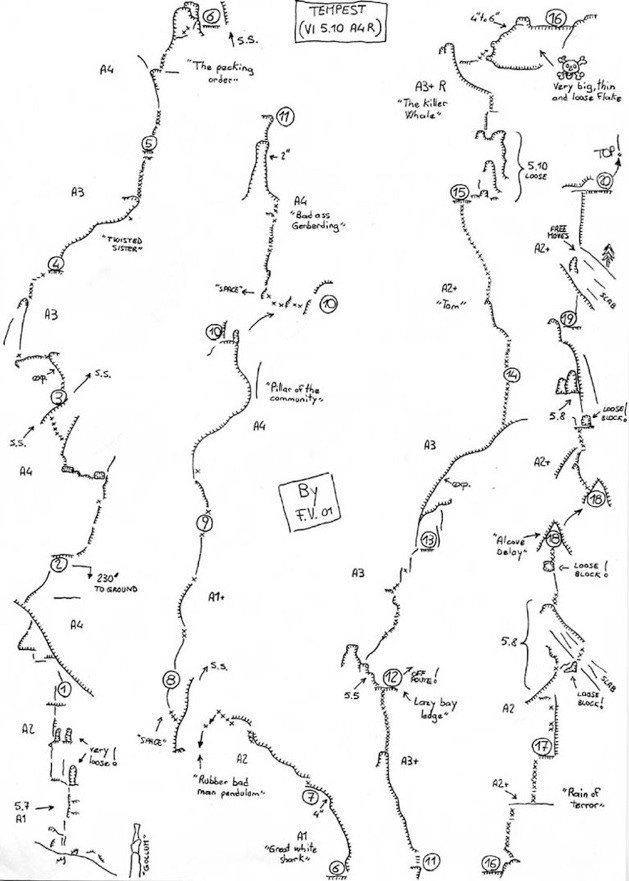
I complicate much of the climbing by never having quite the right amount of gear on me. I play with tagging up a bag on a Fifi hook, but it takes too long to reset. Backcleaning is the penance for poor planning. The topo calls for 40 beaks, which I reluctantly clip to myself for only the crux pitch. Time delays have started to feel more consequential. I’m racing an atmospheric river. The storm is due Wednesday night, and I need to be at the Lazy Day Ledge at the top of pitch 12 before then.
Tuesday, I head out on the crux pitch, weighed down by my gear, my apprehension of the difficulty of this pitch, and the time stress. I get lost. Lured left by a line of rivets and old tat waving in the wind, I can’t figure out the start. I’ve done some tricky climbing to move left, and now every direction feels wrong. I crumble. I’ve been moving nonstop for almost a week. My nerves are floss; my hands are on fire; I can’t do it. I’ve kept repeating- I’m indefatigable; time doesn’t exist; pain doesn’t exist. But I’m exhausted, and I’m running out of time, and my right hand barely works. I’ve never cried soloing before, but I’m sobbing into the rock. I can’t be tough anymore; I can’t climb anymore; I’m scared, and I’m alone, and I don’t know what to do. Crying doesn’t help, but I can’t stop, and then I realise that it does help a bit, because I can splash my ultimatum of “you have to be tough” all over the wall. I call a friend. I texted two others for directions. I don’t care anymore. I have to figure it out before the storm. I forgive myself for the tears, for the phone usage. It’s my first A4 route. It’s nice to hear someone else’s voice, and eventually, comparing the colour of the rock to the picture in the book, I figure it out.
Ironically, once I’m in the right spot, I don’t find the climbing to be very difficult. I thought many of the other pitches on this climb were harder and more consequential. I hold on to this experience–don’t make assumptions about pitches and grades and psych yourself out.
I make it to the ledge the next day, having wasted too much time lost in Space. The next A2 pitch has a hook move off the anchor so reachy that I’m tiptoeing and pushing the hook up with my fingertips, followed by three more hook moves to a dubious offset cam. I don’t understand these grades. On my way up, I understand why removing distractions like the phone is so important. I climb past plants for the first time and fall into the colour green, the patterns of the leaves, the wonder of life growing in the sky. I’m enraptured by a bug; its markings are so intricate that they seem more meaningful. I’ve never felt so zoomed in before. Up higher, I eat lunch with a fly that can miraculously contort its legs behind its head. These are the first living things I’ve seen up close in a week. I feed the fly a crumb of cheese.
I get storm-ready. The wind portends the storm to come and turns the portaledge into a windsail. With mounting anxiety, I organise the anchor and my gear. I recognise this feeling; it’s how I felt when I got hit by a storm last year, my first time up El Cap. My body is locked, my teeth are fused, tunnel vision, like the world is screaming ‘danger’ at my very being.
Cold and rain are the prelude to the storm. That night, the wind gets so bad I think the fly is going to get ripped off and sucked into the void. The wind howls, the fly bows in, the ledge pitches up and down even though it’s tied to the rivets underneath me. I vacillate between staring at the fly to will it in place and trying to stare at my book. All of a sudden, my vision flashes bright white, horizontally, and then cuts out completely. Time feels strange. I know it couldn’t have lasted long, but I have enough time to think and accept the thought- I’m blind now and feel perplexed- when a giant boom of thunder explodes. The thunder is so immediate and complete that I feel suspended in the middle of it; I feel it in my body, feel a humming in my belly. It growls for a long time before it dies off.
It takes me forever to remember how to breathe without thinking about it. Lightning strikes twice more, but further away. I’m so scared and tired that I don’t comprehend the proximity of the lightning strike until the next day. The wind continues to rip relentlessly at the fly. The rain is intensely loud. I try to remain watchful, but paradoxically, the storm's aggression makes me want to go to sleep. Fight, flight, freeze, snooze, I guess.
I spent a total of 11 nights in that spot, 8 pitches from the top. In the beginning, time stretches out unbearably. My world takes on the red hue of my ledge fly and shrinks into a slightly tilted, damp pyramid shape. The weather report just looks worse and worse for days, and when I think about how long I’ll have to stay here, I feel very small. I count the days of the week, gallons of water, and meals on my fingers out loud, over and over again. I hesitate to start my book because I don’t want to finish it and then have nothing to read. I feel suspended. To have no control over anything, no way of going up or down, to only be able to lie down and wait–I’ve never been good at waiting. This is a big lesson in accepting.
It rains and snows, and during breaks in the weather, I try to fix pitches. My new mantra: unfailingly positive. I’m camped under runoff and live in my own personal rainstorm even when the sky clears up. I wake up some mornings encapsulated in ice, the fly frozen solid. Drips and condensation ensure that nothing is ever fully dry. I’m in a liminal space, stuck in the place I dream of. I think of it as enduring. It gets better, though. I never spend more than 2 days sequestered in the ledge. I drink a little more than a litre of water the first two days when the weather report looks hopeless, and when I fix pitch 13 (baby beaks marching up a thin wet seam above a ledge, a breathless hook to get around a ripped out head, so focused on outclimbing the rain I forget to clip the rivets!) I feel terrible. After that, I drink 2L/day in the ledge, more if I’m climbing. Fixing that pitch, upward movement and a respite from my horizontal refuge was the glimmer of hope I needed.
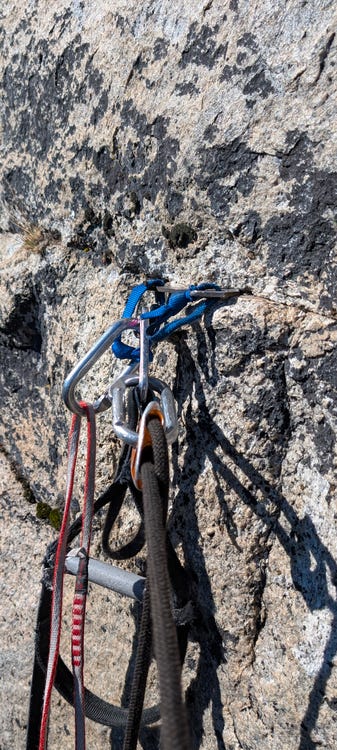
I scheme endlessly on how I’ll divvy up my food and water. Eventually, though, when the weather looks like it’s getting better at the end of the week, I can relax a little about supplies. I feel more comfortable in my little nook on the side of this mountain. I truly feel sheltered by the mountain and feel that if I can step up to this challenge, I’ll be rewarded with safe passage to the top. The time on the ledge is good for my hands. I recover some dexterity, and the numbness and tingling go down. I nap a lot. I read, I write, I wonder about the world. I play crosswords and eat snacks whenever. I watch the storm and the valley. Hope grows with conviction.
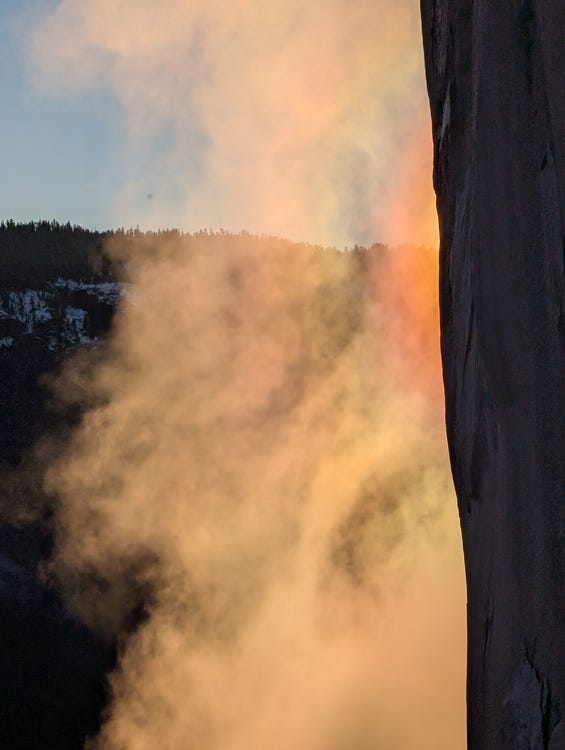
The fog is beautiful. One day I lay on my belly and watch a rainbow that plays through coalescing clouds, dancing in the evening sun. From the higher pitches, I can see Half Dome, and when I look at the High Country, I start to cry. I can’t believe I get to spend so much time here, not just on this mountain but here in Yosemite, in this community. My first meltdown loosened something in me, and tears flow for all sorts of reasons. You can be brave and cry. I still feel like it’s a privilege to be up here, even though I’m cold and I want to get down.
It takes me two days to fix pitch 14, which feels very discouraging. It seeps terribly. I get soaked after the second half, leggings, pants, triple upper layers becoming a hypothermic trap. As I’m rapping back to the ledge, I chatter, ‘you’re gonna be ok’ on repeat out loud, interspersed with admonishments to not drop my grigri. I sound like a lunatic. I’m so cold. I get hung up on the fly getting into my ledge, and I lose it. I’m screaming at the ledge, screaming at the mountain. This is panic, the collapse of any boundaries I have left against terror.
Once I’m stripped of my wet layers and zipped back up in my sleeping bag, I’m embarrassed about my freak-out. I wonder if anyone heard me. I doubt it. I think I’m the only one left on this side of the mountain. This situation is real, more real than anything I’ve ever found myself in before. So these emotions are real too, and they need to come out; they need a voice. I’ve stayed mostly calm and collected, breathed it all down. And now I realise, kicking and screaming will work too. I’m getting to the top of this mountain, and I’m going to fight like hell to get out of this; I will not go gently into the night. Kicking and screaming becomes my new mantra.
On pitch 15, I hook around a hollow-sounding flake even though I see hammer marks. I’m learning. I stay at the Lazy Day Ledge an extra night because I need sunshine to dry my clothes out, and because I’m practising ultra-patience to not get wet again. I’ve finished one of my books and misread an Emily Dickinson quote in my book as “Hope is the thing with bright red feathers”. From then on, I imagine bright red feathers out of the corners of my eyes, winking brightly on this sea of granite, winging upwards. Always upwards.
After 12 days in one spot, I leave the ledge. I feel very vulnerable leaving my spot of relative safety to ascend into the unknown. I haul 4 pitches, lead and haul the fifth, and set up at the first good ledge of the route. The last pitch involves another hook taped to the stickclip. Exciting. The next day I want to fix up three pitches to the top. I had read about a rescue in 2005 on the upper pitches because the runoff there is bad, so I don’t want to move my camp up. Why I assume the climbing will be easier as I get closer to the top, I don’t know, but it’s not easy, and I should have gotten up earlier. I can’t figure out the start of the last “C1” pitch. I hook right, swing around off the anchor, and rail against the new topo. As the sun sets too early again, I’m hanging on the rope, frustrated and lost again, but I interrupt my own diatribe to admire Yosemite. Half Dome is bathed in purple light. The wintry high country is accented with fresh snow. Stars blink on as the light fades.
The old topo indicates a copperhead seam, which the new topo points to with an arrow saying “no”. I see no fixed heads in the seam, and I left most of my beaks at a lower anchor because I thought it was going to be C1. But I want the top more than anything in the world; backing down is not an option. I feel like I’m having an out-of-body experience. My mind is resistant, but my body is already moving, ready to bump 2 baby beaks if that’s what it takes to get to the top. My friend says you literally can’t die within 10 feet of a bolt-so what’s 20? Baby beak, baby beak, and a medium that holds a downward pull. Just like ice climbing but worse. I reachy draw a fixed cable (it’s a beak!), I lasso the edge of a horn when I can’t mantle up (I don’t care anymore), and finally-finally-I’m chugging up an actual crack. I reach the ground, oh ground, thank you, tie myself to the first tree I see, and plunge back into the darkness, back to the security of my shelter. The ground is too windy, too open, too cold.
2 days after my departure from the Lazy Day Ledge, I hauled my things up to the summit tree. It’s already late afternoon; the bags kept getting stuck on the last haul. I am so grateful. I sit, hugging my haul bag, holding my turtle, and crying happy tears. That it was hard is an understatement. I hug the summit tree and press my face into the fractured bark.
I find a nice bivy spot and eat my last dinner. I sleep one final night on the mountain, this time listening to the trees instead of the distant sounds of the Valley. I’m awakened early by a ringtail, boldly trying to steal my food. I enjoy the mammalian interaction, though. I’m snuggled up in my sleeping bag, propped up against a rock, and watching the sunrise. The hecticness of every other morning melts away. As the colours wash through the sky, I read my book, drink coffee, and feel intensely peaceful. My second book, an Alan Watts book about Zen, talks about the illusion of the self, and I’m glad I didn’t read much of it in the ledge, glad I kept a hold on myself, didn’t get lost in nothingness and non-doing. It is important to keep going.
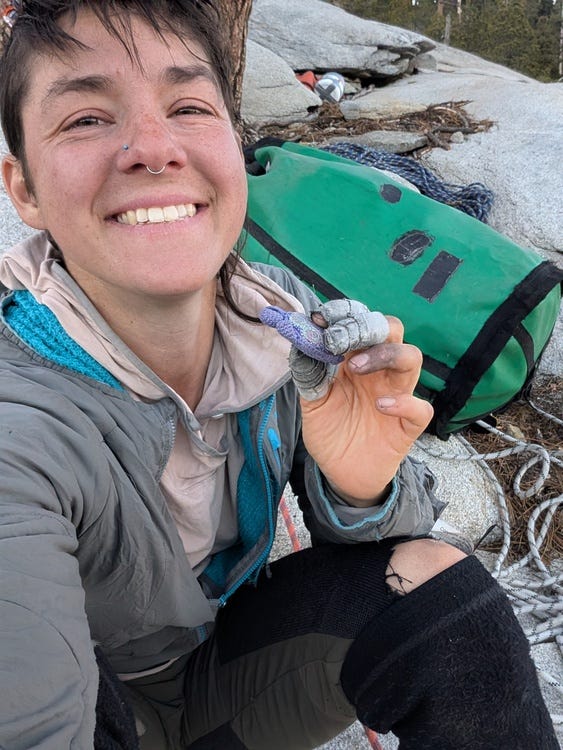
The adventure wasn’t quite done. I epic’d one more time trying to hike my 3 bags down in one day. I ended up leaving 2 clipped to the second rap station in pure frustration on the East Ledges and tottering down in the dark to a dead truck battery and a camper that had been completely taken over by mice. Wall climbing, baby! But to experience such a spectrum of emotions and events in a day, in three weeks, and to be welcomed by friends with open arms at the end of it, the night before Thanksgiving– I wouldn’t trade this for anything.
Adriana Sabella 2025
You can read Miles Fullman’s interview with Adriana about here first female one-day solo of Zodiac here.
Thanks for this Andy. This is a really raw account of an adventure. Engaging right till the end!
The most engaging trip report I’ve read in ages (and honestly the first one I’ve read all the way through in years). Thanks for reposting!